
 Free Estimate
 Request Service
 Locations

What Does It Mean to Fix a Roof Joist and Can You Do It Yourself in Metro Detroit?
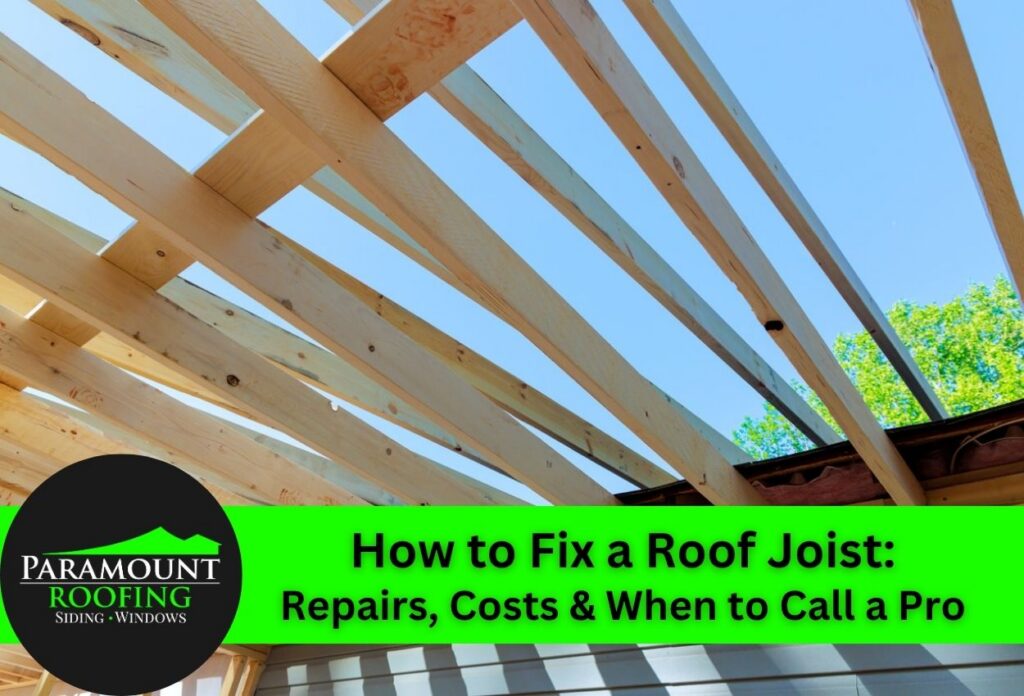

In residential framing, roof joists support the roof and typically span 12 to 20 feet. Damage that noticeably reduces a joist’s cross-section generally requires structural intervention, not a DIY patch job. Three repair approaches cover most situations: sistering a new board alongside the damaged joist, splicing in a section to replace the compromised area, or pulling the joist out entirely and installing a full replacement. The Michigan Residential Code requires permits whenever weight-bearing framing members are altered, reinforced, or replaced, so all of these repairs must meet permit requirements.
The conditions that lead to joist damage are predictable in Southeast Michigan. The region sees an average of 45 inches of snowfall annually, and repeated temperature changes cause moisture to work its way into roof framing over time. Mid-20th century ranch and Colonial homes across Macomb, Oakland, and Wayne counties were built in an era before modern moisture barriers, making them especially vulnerable.
How Do You Know If a Roof Joist Is Actually Damaged Enough to Repair?
Four categories of damage determine whether a joist needs monitoring, sistering, a full replacement, or immediate structural support. Cracks are measured by how deep they run through the joist, while rot is measured by how much of the cross-section it has removed, so the two use different percentages. Identifying the right category before touching anything can save thousands of dollars in unnecessary work.
- Surface checking or shallow cracking: Shallow, small cracks running along the grain that do not extend past the outer layer are cosmetic. Monitor these over one to two seasons but hold off on repairs unless the cracking spreads or deepens. Cracks that go deeper than the surface but stay under 50% of the joist depth should be measured, marked, and rechecked every few weeks, and evaluated by a professional if they grow.
- A crack extending through more than 50% of joist depth: This level of damage compromises the joist’s weight capacity. Sistering, or attaching a full-length board alongside the damaged joist, is the standard fix at this threshold.
- Rot affecting more than ⅓ of the joist’s cross-section: Rot this deep cannot be stabilized with sistering alone. The joist requires a full replacement. Rot that runs more than about 24 continuous inches along the joist also calls for a full replacement, even when it is shallower than ⅓ of the cross-section.
- Visible sagging or bending exceeding 1 inch over a 10-foot span: This is the most urgent issue, and the structure needs immediate temporary support before any repair work begins.
Rafters and ceiling joists are not the same thing. Rafters slope up to the ridge and carry the constant weight of the roofing materials and the seasonal weight of snow, while also resisting wind pressure. Ceiling joists run horizontally, carry ceiling and attic weight, and in conventional framing act as ties that resist the outward push of the rafters. A cracked rafter is generally more urgent than a cracked ceiling joist at the same depth of damage, though a ceiling joist that is serving as a rafter tie deserves the same caution. Any homeowner dealing with a cracked rafter should treat the repair as a higher priority.
In metro Detroit, look for three moisture indicators specific to this climate: staining along framing consistent with ice dam water backup, frost or mold on attic framing, and rot concentrated around flashing openings. Older homes built before 1980 in Macomb and Oakland counties frequently have these issues, especially around plumbing vents and chimney framing where older roof flashing details allow leaks over time.
What Are the Main Methods for Repairing a Damaged Roof Joist?
Sistering is the most common repair method for a damaged roof joist, but the right choice depends on where the damage is, how severe it is, and whether the framing is stick-built or trussed. The table below compares four repair methods side by side:
| Repair Method | Best For | DIY Difficulty | Estimated Labor Time |
|---|---|---|---|
| Sistering (parallel reinforcement) | Cracks deeper than 50% of the joist’s depth, or rot affecting up to ⅓ of the cross-section; full-length access available | Moderate | 2 to 4 hours per joist |
| Splice Repair (mid-span damage) | Localized rot or damage in the middle section of a joist | High | 3 to 6 hours per joist |
| Full Replacement | Rot affecting more than ⅓ of the joist’s cross-section or running more than about 24 continuous inches; severe bending | Extreme | 6 to 10 hours per joist |
| Structural Connector Reinforcement | End connections, bearing point failures, or minor splits near joist ends | Low | 1 to 2 hours per joist |
Sistering a roof joist simply means attaching a sturdy new board alongside the damaged one to strengthen it. Start by choosing a new board that matches the original wood type and size, usually standard dimensional lumber like Douglas Fir or Southern Yellow Pine. The new piece should run the full length of the damaged joist where access allows, and never less than 3 feet past each end of the damaged area. Secure it with 3-inch structural screws or 16d sinker nails spaced every 12 inches in a staggered pattern, and confirm the required schedule with your local building department. A splice repair can work if the damage is only in the middle of the joist, though it requires extra support blocks and may need a structural professional to review the setup before starting.
Engineered trusses, common in homes built since the 1970s and standard in most newer buildings in Plymouth, Oxford, and Romeo, cannot be sistered or field-modified without a structural engineer’s stamped repair plan. Older stick-framed homes across the Detroit metro area use traditional joists that allow field repairs; newer truss systems do not. Confusing the two can void warranties and violate the Michigan Residential Code.
How Do You Sister a Roof Joist Step-by-Step?
Sistering a roof joist requires five steps in a fixed order, and skipping or reversing any step risks structural failure or drywall damage below. Here is the full sequence:
- Install temporary support first: Place a hydraulic bottle jack with a minimum 2-ton capacity under the damaged joist at mid-span. Set a 4×4 post between the jack and a solid bearing surface. Do not remove any fasteners or cut any lumber until this support is in place.
- Lift sagging joists slowly: If the joist has sagged more than 1 inch over a 10-foot span, raise it no more than ⅛ inch per day. Lifting faster cracks the ceiling drywall below and stresses adjacent framing connections.
- Size and cut the sister board: Match the new board to the existing joist’s full depth using dimensional lumber no thinner than the original joist. The sister board should run the full length of the damaged joist where access allows, and never less than 3 feet past each end of the damaged area. Use a wood board that matches the original lumber grade.
- Fasten with a staggered pattern: Drive 3-inch structural screws or sinker nails in a staggered pattern every 12 inches along the full sister length. This pattern is common field practice for sistering; the local building department or a structural engineer can confirm the required schedule for your framing. Use a drill or screwdriver with a #3 square-drive bit and a framing square to keep spacing consistent.
- Re-attach the roof deck if it was disturbed: If the roof deck was lifted or cut during access, fasten it back to the new sister board using the same nail schedule as the original installation.
Schedule this work during early morning hours and open as many vents as possible before starting to avoid overheating during summer repairs. Complete each step in order and do not remove the temporary jack until all fasteners are fully driven and inspected.
When Does a Rotted or Severely Damaged Joist Require a Full Replacement Instead of Repairs?
A full joist replacement is generally recommended when any one of the following applies: rot extends more than about 24 continuous inches along the joist, rot affects more than ⅓ of the cross-section, damage occurs within 6 inches of the wall plate bearing point, or mold has reached the full joist cross-section. These are common rules of thumb; a structural engineer or building official makes the final call. When three or more adjacent joists show this level of damage, have a structural engineer evaluate the framing before any repair work begins, including any DIY attempt.
- Rot spanning more than 24 continuous inches: Even when the rot is shallow, sistering cannot transfer weight reliably across a compromised section this long. A full replacement is recommended.
- Damage within 6 inches of the wall plate: Bearing point damage undermines the entire weight path from the roof to the wall. Replacement is typically needed regardless of rot depth elsewhere.
- Mold through the full joist cross-section: Surface mold can sometimes be treated, but full-depth mold indicates the wood fiber has broken down structurally. A full replacement is recommended.
- Three or more adjacent joists affected: This is a systemic failure, not an isolated repair. Have a licensed structural engineer review the framing before work starts.
What a Full Replacement Actually Involves
Understanding how to replace a rotted roof joist means recognizing that the project differs significantly from sistering. In a finished attic, temporary ceiling support must be installed, and the interior finish or roof deck covering the damaged joist must be removed before it can be pulled. That process adds 4 to 8 hours of labor compared to a straightforward sistering job. When the damage is extensive enough to warrant a full replacement, homeowners should consider a professional residential roof inspection to identify any additional structural concerns before work begins.
Michigan Permit Requirements
A structural framing replacement in residential roofs in Michigan typically requires a building permit from the local municipality. Inspections add 3 to 10 business days to the project timeline. Skipping the permit creates two serious risks: structural repairs performed without a permit can complicate homeowners insurance claims after a future storm or leak, and they must be disclosed during resale under Michigan law. The permit process exists to protect the homeowner, not just the contractor.
If any of the four replacement thresholds above apply to a joist in the home, contact a licensed roofing contractor to assess the full extent of damage before pulling a single fastener.
What Does It Cost to Fix a Roof Joist, and Is DIY Worth It?
Professional joist repairs in Metro Detroit cost significantly more than materials alone, but deferred repairs can turn a minor fix into an $8,000 to $18,000 full roof replacement. The table below breaks down real costs by repair method.
| Repair Method | DIY Material Cost | Professional Total Cost (Metro Detroit) |
|---|---|---|
| Sistering | $40 to $80 per joist | $250 to $450 per joist |
| Splice Repair | $30 to $60 per joist | $200 to $350 per joist |
| Full Single Joist Replacement | $60 to $120 per joist | $400 to $700 per joist |
A professional repair costing roughly $200 to $700 caught early is one of the highest-return-on-investment decisions a homeowner can make. Left alone, joist damage that reaches the roof deck can force a full roof replacement costing $8,000 to $18,000 on a typical home in Metro Detroit. Catching damage at the joist stage, before the roof deck fails, is the most cost-effective point to act.
One more step matters before any work starts: Document all damage with timestamped photos. Most standard homeowners insurance policies in Michigan cover joist damage caused by sudden events like storms or falling trees, but they exclude gradual rot or deterioration. Contact the insurer before repairs begin, so the claim stays valid and the documentation is in place.
Ready to Fix a Roof Joist in Southeast Michigan? Here’s Your Next Step.
Catching joist damage early, before it reaches the deck, is the difference between a straightforward repair and an expensive full roof replacement. Early fall is the best window to act in Metro Detroit. Once snow starts falling and temperatures begin to drop, structural damage accelerates fast, and roof access becomes limited.
Paramount Roofing provides roof joist evaluations, structural repairs, and permitted construction for homeowners throughout the Detroit region, including Oxford, Plymouth, and Romeo. To determine whether your roof joists require repairs or a full replacement, schedule a roof inspection with our team.
Not ready to schedule? Learn more about residential roof repair services.