 Free Estimate
 Request Service
 Locations
What Does a New Roof Installation Look Like in Detroit? Do You Actually Need One?
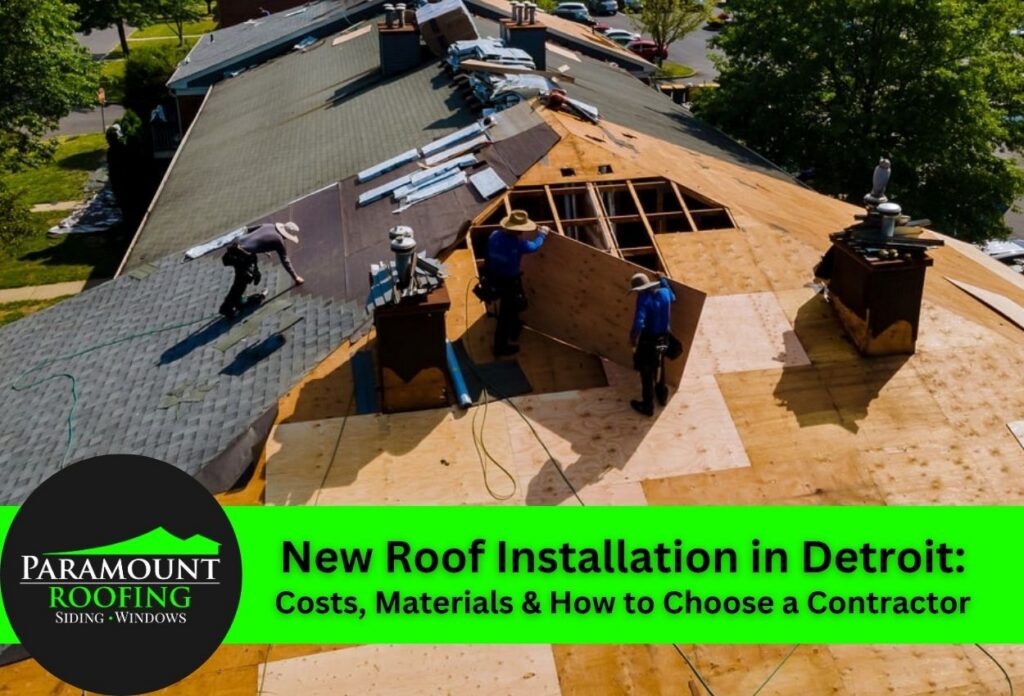

New roof installation in Detroit means fully removing your old roofing material, inspecting and repairing the roof deck underneath, installing ice-and-water barrier, underlayment, flashing, and new shingles, then passing a local building department inspection, not simply laying new shingles on top of old ones. That distinction matters, because an overlay hides problems rather than fixing them.
Detroit’s housing makes this especially relevant. Most bungalows, brick colonials, and cape cods in the city and metro area were built in the early to mid-1900s. Roofs on these homes have often seen decades of freeze-thaw temperature changes, heavy snow, and Great Lakes weather. By the time a homeowner notices a leak or curling shingles, the boards of the roof deck underneath may already be soft, warped, or rotted problems that only show up once the old material is stripped away.
A full replacement addresses those hidden issues and brings the home up to current Michigan building code standards, including proper insulation and ventilation requirements. Patching or overlaying an aging roof on a 70-year-old Detroit home usually costs less upfront but rarely solves the underlying problem.
This guide covers every decision a Detroit homeowner will face: material options, contractor selection, seasonal timing, total costs, and permitting steps.
Why Detroit’s Climate Makes New Roof Installation More Demanding Than Most Markets
Detroit’s humid continental climate creates four distinct seasonal stresses on residential roofing systems: cold winters with average highs near 32 degrees Fahrenheit in January, hot summers near 84 degrees in July, about 33 to 34 inches of annual precipitation, and snowfall, and every one of them shortens roof life if the system is not installed correctly from the start.
Winter Cold, Snow, and Ice Dam Risk
Ice dams are the single most damaging winter roofing threat in Detroit. When heat escapes through an under-insulated attic, it warms the roof deck and melts the bottom layer of snow. That water runs down the slope until it hits the cold eave overhang, refreezes, and builds a ridge of ice. The next melt cycle has nowhere to go; water backs up under the shingles and soaks directly into the roof deck. On a home that has gone years without attention, the boards of the roof deck can become soft, warped, or rotted by the time a contractor strips the old material away.
This is why ice-and-water shield along the eaves is both a practical necessity and a code-relevant requirement on Detroit roofs, not an upgrade. Skipping ice-and-water shield on a Detroit home is one of the most common reasons a roof fails prematurely.
Great Lakes Weather and Wind-Driven Damage
Detroit’s proximity to the Great Lakes adds weather hazards beyond typical cold-climate markets. While the city generally avoids the severe lake-effect bands that hit western Michigan, standard winter storms still regularly dump heavy, wet snow that puts immense weight on roof structures. Summer thunderstorms bring hail, high winds, and heavy rain, all of which test the weakest points of any roofing system. Drip edge keeps wind-driven rain from working under the roof deck at the eaves and rakes.
Properly sealed roof flashing around chimneys, vents, and valleys stops the water that shingles alone cannot redirect. Ridge ventilation reduces the heat and moisture buildup that accelerates shingle breakdown from the inside. When any one of these components is installed poorly or left in deteriorated condition, the rest of the system works harder and fails sooner.
Detroit’s climate does not forgive shortcuts. That is exactly why the contractor a homeowner chooses someone with direct experience installing roofs in this market makes as much difference as the material itself.
What Roofing Materials Work Best for New Roof Installation in Detroit, MI?
Material choice is the single largest variable in both upfront cost and long-term roof performance, and heavy snow, temperature changes, and hail risk eliminate several options from serious consideration before the conversation even starts.
| Material Type | Typical Lifespan | Approx. Cost Per Square (Installed) | Detroit Climate Performance | Best For |
|---|---|---|---|---|
| 3-tab asphalt shingles | 15 to 20 years | $150 to $250 | Below average low wind and impact resistance | Short-term budget replacements only |
| Architectural/dimensional asphalt shingles | 25 to 30 years | $250 to $450 | Good at handling temperature changes and moderate hail | Most Detroit residential projects |
| Impact-resistant asphalt shingles | 25 to 35 years | $350 to $550 | Very good Class 4 impact resistance, hail and wind rated | Hail-prone neighborhoods; insurance discount eligible |
| Standing seam metal | 40 to 70 years | $700 to $1,400 | Excellent sheds snow, no granule loss, temperature-stable | Steep-slope and historically significant Detroit homes |
| Designer/premium asphalt shingles | 30 to 50 years | $500 to $900 | Very good heavier construction, strong wind ratings | Higher-end homes where curb appeal matters |
Architectural shingles are the dominant choice for most Detroit homeowners because they balance cost, weather performance, and warranty coverage better than any other option in that cost range. Homeowners on steep-slope roofs or historically significant homes in neighborhoods like Indian Village or Boston-Edison should price standing seam metal roofing systems seriously; its 40-to-70-year lifespan often makes it the better long-term investment despite the higher upfront cost. Impact-resistant shingles are worth the premium for any Detroit home that has filed a hail claim in the past, since many insurers offer reduced rates for Class 4 impact resistance.
How Much Does New Roof Installation Cost in Detroit, Michigan?
Cost is the first question most Detroit homeowners ask, and local pricing is shaped by labor rates, material availability, the age and complexity of the existing housing, and how much roof deck repair the job requires once the old material is stripped away.
| Cost Item | Low | Mid | High |
|---|---|---|---|
| 3-tab asphalt (per square installed) | $150 | $200 | $250 |
| Architectural asphalt (per square installed) | $250 | $350 | $450 |
| Impact-resistant asphalt (per square installed) | $350 | $450 | $550 |
| Metal roofing system (per square installed) | $700 | $1,050 | $1,400 |
| Tear-off and disposal | $1,000 | $1,750 | $2,500 |
| Roof deck repair or replacement (per sheet) | $75 | $100 | $150 |
| Ice-and-water shield | $200 | $400 | $700 |
| Permits and inspections | $150 | $300 | $500 |
| Flashing replacement | $200 | $450 | $800 |
Roof deck repair costs catch many homeowners off guard. On older Detroit Bungalows and Cape Cods, soft or rotted boards are common once the old material comes off, and replacing multiple sheets adds up fast at $75 to $150 per sheet.
| Roof Area | Low Estimate (Architectural Asphalt) | Mid Estimate (Architectural Asphalt) | High Estimate (Architectural Asphalt) |
|---|---|---|---|
| 1,000 sq ft | $4,500 | $6,000 | $7,500 |
| 1,500 sq ft | $6,000 | $8,500 | $11,000 |
| 2,000 sq ft | $7,500 | $11,000 | $14,500 |
| 2,500 sq ft | $9,500 | $13,500 | $18,000 |
These ranges cover tear-off, ice-and-water shield, underlayment, architectural shingles, flashing, and permit the full scale a proper Detroit replacement requires. The lowest bid rarely reflects the full scale of work; a quote missing line items for ice-and-water shield, flashing replacement, or roof deck inspection is almost certainly leaving out real costs that will surface mid-project. Compare every estimate on a line-item basis. Section 9 covers exactly what to look for when reviewing contractor quotes so nothing gets missed.
What Does the New Roof Installation Process Look Like From Start to Finish?
A typical Detroit single-family home takes 1 to 3 days of active installation once materials are on-site, but total project time from signed contract to permit close-out commonly runs 2 to 6 weeks depending on contractor backlog, weather, and inspection scheduling. Knowing each step ahead of time helps homeowners set realistic expectations and catch any contractor skipping steps that matter. Detroit’s local building department requires inspection checkpoints that cannot be rushed, and the steps below reflect that full sequence.
- Initial inspection and damage assessment. A contractor evaluates the existing roof surface, roof deck condition, flashing, and attic ventilation. This sets the scale of work and surfaces hidden costs like the soft roof deck boards common on older Detroit bungalows before a contract is signed.
- Material selection and contract signing. Homeowner and contractor agree on material type, color, and manufacturer. The contract should list every line item: tear-off, ice-and-water shield, underlayment, flashing, permits, and deck repair allowance.
- Permit application with the local building department. Most Detroit-area municipalities require a permit before work begins. Permit processing adds days to the timeline but protects the homeowner by triggering mandatory inspections.
- Scheduling and material delivery. Shingles, underlayment, and accessories are delivered and staged. Delivery timing is coordinated to avoid leaving materials on-site too long before installation starts.
- Tear-off of existing roofing. Old shingles, underlayment, and degraded flashing are stripped to the bare roof deck. This is where hidden roof deck damage shows up and why a roof deck repair allowance of $75 to $150 per sheet should be in every contract.
- Roof deck inspection and repair. Every board is checked for rot, softness, or warping. Damaged sections are replaced before any new material goes on. Skipping this step means new shingles are installed over a compromised foundation.
- Installation of ice-and-water shield at eaves and valleys. This self-adhering membrane runs along the eaves and into valleys, the two zones most vulnerable to ice dam backups in Detroit winters. It’s a code-relevant requirement, not an optional upgrade.
- Synthetic or felt underlayment across the field. A layer of #15 or #30 roofing felt, or a synthetic alternative, covers the rest of the roof deck and adds a secondary moisture barrier beneath the shingles.
- Drip edge and flashing installation. Metal drip edge goes along eaves and rakes. Step flashing, counter flashing, and valley flashing seal every roof gap, chimneys, vents, and skylights.
- Shingle installation. Shingles are installed from the eaves up, following the manufacturer’s nailing pattern and exposure requirements to preserve warranty coverage.
- Ridge vent and ridge cap. A continuous ridge vent allows warm, moist attic air to escape, reducing heat buildup that shortens shingle life. Ridge cap shingles seal the peak.
- Final inspection and cleanup. The crew removes all debris, runs a magnetic sweep for nails, and the contractor does a walkthrough with the homeowner.
- Permit sign-off. A local building inspector reviews the completed work. This final sign-off is the homeowner’s documentation that the roof was installed to code; skipping it creates problems at resale and with insurance claims.
Rushing any step, especially the permit and inspection checkpoints, can void manufacturer warranties and complicate future insurance claims. Confirm with your contractor before work begins that every step in this sequence is included in the project’s scale.
What Permits and Regulations Apply to New Roof Installation in Detroit?
A full tear-off and replacement in Detroit requires a local building permit no exceptions. Michigan does not issue a single statewide roofing license, but contractors performing residential roofing work must hold an appropriate state-level license category: residential builder, maintenance and alteration contractor, or a comparable subcategory that covers roofing work. Homeowners should ask any contractor to show proof of that license before signing a contract.
Local Permits and Inspection Stages
Detroit and most surrounding municipalities require a permit pulled through the local building department before roofing work begins, not after. Once work is underway, inspectors check defined stages: roof deck condition after tear-off, ice-and-water shield and underlayment placement, flashing installation, and the final completed roof. Each checkpoint is a documentation record that the work was done correctly. Permits commonly run $150 to $500 depending on the municipality and project scale, a cost that should appear as a line item in every contractor quote. Any contractor who tells a homeowner a permit is not needed for a full roof replacement is a red flag, and skipping permitting can create serious problems at the time of an insurance claim, a home sale, or if the installation fails.
Michigan Building Code Requirements That Affect Detroit Roofs
Michigan’s adopted residential building code for 1- and 2-family dwellings sets the standards most relevant to Detroit homeowners during a reroofing project. Snow weight ratings govern how the roof structure must perform under winter accumulation. Wind resistance classification for shingles determines the minimum rating required for this region.
Ice-and-water shield must be installed at the eaves, typically covering the area from the roof edge to a point at least 24 inches inside the exterior wall line because ice dams are a documented risk in Detroit’s climate. Energy code requirements may also affect attic ventilation and insulation levels when the roof deck is being replaced, meaning a reroofing project can trigger an inspection of whether the attic assembly still meets current code minimums.
Homeowners who skip the permit process do not just risk a fine. They risk voiding the manufacturer’s warranty, losing coverage on a future insurance claim, and facing disclosure problems when selling the home. The $150 to $500 permit cost is the least expensive protection in the entire project budget.
When Is the Best Time of Year to Schedule New Roof Installation in Detroit?
April through May and September through October are the best windows for new roof installation in Detroit, offering mild temperatures, manageable precipitation, and conditions where shingles seal and adhere properly. Most roofing manufacturers recommend installation temperatures above 40 degrees Fahrenheit, a threshold Detroit regularly falls below from November through March. Planning around that window can affect both the quality of the finished roof and what homeowners pay.
| Season | Average Temperature Range | Installation Feasibility | Key Risks | Demand / Wait Time |
|---|---|---|---|---|
| Spring (Apr to May) | 59 degrees to 70 degrees highs | Excellent | Rain delays; highest contractor backlog after winter damage discoveries | High demand; 2 to 6+ week lead times common |
| Summer (Jun to Aug) | 80 degrees to 84 degrees highs | Good | Heat affects shingle handling; crew scheduling tightens | Moderate to high book early |
| Fall (Sep to Oct) | 62 degrees to 74 degrees highs | Excellent | Shorter daylight hours as season progresses | Moderate, often shorter wait than spring |
| Winter (Nov to Mar) | 32 degrees to 49 degrees highs | Limited | Frozen roof decks, adhesive failure, snow removal required before work starts, safety risk | Low demand but quality risks are real. |
Spring brings the highest demand of the year for Detroit roofing contractors. Homeowners who discover winter storm damage and wait until May or June to call often face longer lead times and less scheduling flexibility. Booking in early April or late fall, September through October, is the most practical way to get faster scheduling without sacrificing installation quality.
Emergency replacements sometimes cannot wait for ideal conditions. When winter installation is unavoidable, responsible contractors adjust their approach: using cold-weather sealants rated for low temperatures, hand-nailing shingles instead of relying on pneumatic nailers that underperform in the cold, clearing snow and ice from the roof deck before any material goes down, and applying temporary protective coverings if work must pause overnight. These steps add time and cost, but skipping them in cold weather leads to adhesion failures and voided warranties. Ask any contractor performing winter work exactly which cold-weather measures are included in the project and job scale before signing.
How Do You Choose the Best Roofing Contractors for New Roof Installation in Detroit?
The contractor you hire matters as much as the materials you choose, especially in Detroit, where aging housing, strict permit requirements, and harsh seasonal conditions demand genuine local expertise. A poor hiring decision can leave homeowners with failed installations, voided warranties, and no legal recourse. Use the seven criteria below before signing any contract.
- Verify the Michigan state contractor license. Michigan requires residential roofing contractors to hold a residential builder, maintenance and alteration contractor, or comparable state-issued license that covers roofing work. Ask to see the license number and verify it directly with the state before work begins.
- Confirm active general liability and workers’ compensation insurance. General liability coverage protects your property if damage occurs during installation. Workers’ compensation protects you from liability if a crew member is injured on your roof a real risk on steep-slope residential roofs common across Detroit neighborhoods.
- Check local reputation through Google, BBB, and neighborhood-level references. Look for contractors with verified reviews in Detroit and the surrounding metro area, not just generic five-star ratings. Ask for references from jobs completed within the last 12 months in your area.
- Review the written estimate for line-item detail. Every cost should be broken out separately: materials, labor, permit costs of $150 to $500, roof deck repair allowance of $75 to $150 per sheet, and disposal fees. A single lump-sum bid with no breakdown is a warning sign.
- Ask who pulls the permit and manages inspections. Reputable contractors pull the permit themselves and coordinate each inspection stage with the local building department. Any contractor who asks the homeowner to pull their own permit is shifting responsibility they should carry.
- Evaluate communication before signing. How fast a contractor responds to calls and emails before the contract is signed tells you exactly how they will communicate once the project starts. Slow response times before work begins tend to get worse, not better, once the deposit clears.
- Understand the full warranty structure. Ask for both the workmanship warranty covering labor and installation errors and the manufacturer warranty covering materials. These are two separate documents, and the best roofing contractors for new roof installation in Detroit will explain both in plain language before asking for a signature.
The best contractor is not always the largest company or the lowest bid. The best choice combines a verifiable Michigan license, real local reviews, manufacturer certification, and a contract detailed enough to protect the homeowner at every stage. Homeowners who want a deeper breakdown of how to compare competing bids should look for a dedicated guide on how to compare roofing quotes in Michigan; that comparison process deserves its own step-by-step review. Paramount Roofing brings that combination of licensing, certification, and transparent contracting to every Detroit-area project.
What Should a New Roof Installation Estimate Include and What Red Flags Should You Watch For?
A complete, written estimate is the only accurate way to compare bids for a Detroit new roof installation, and it protects the homeowner if a dispute arises after work begins. Every professional estimate should spell out the full job scale so bids can be compared on equal terms, not just by the bottom-line number.
A professional estimate for a Detroit residential new roof installation should include all of the following:
- Scale of work: A written description of every task tear-off, roof deck inspection, new material installation, flashing replacement, and final cleanup listed separately, not bundled into a single vague line item.
- Material brand and product line: The specific manufacturer, product name, and shingle grade being installed. “Architectural shingles” with no brand listed is not enough detail to compare bids fairly.
- Number of squares: The total roof area measured in roofing squares (one square equals 100 square feet), which allows homeowners to verify the material quantities being charged.
- Tear-off and disposal method: Whether old materials are stripped to the roof deck, how debris is removed, and whether disposal fees are included or billed separately.
- Roof deck repair allowance or policy: Rotted or damaged sheathing is common on Detroit homes. Estimates should list a per-sheet repair rate typically $75 to $150 per sheet or a written policy on how unexpected roof deck damage will be handled and priced.
- Permit responsibility: A line stating who pulls the permit, with the $150 to $500 permit cost included in the estimate rather than added later as a surprise charge.
- Payment schedule: A breakdown of deposits and progress payments. Most reputable contractors require a partial deposit, not full payment upfront with the balance due upon completion.
- Projected timeline: Start date, estimated duration in days, and any conditions that could affect scheduling.
- Warranty terms: Both the workmanship warranty covering labor and the manufacturer warranty covering materials, listed as separate items with their respective coverage periods.
Red Flags That Should Stop You From Signing
Watch for these warning signs before handing over any money or signature:
- Unusually low bid with no itemization: A lump-sum number with no breakdown makes it impossible to know what is and is not included and what gets cut when costs run over.
- Demand for full payment upfront: Reputable contractors collect a partial deposit, not 100% of the project cost, before a single shingle is removed.
- No mention of a permit: Skipping the permit can void the manufacturer warranty, create insurance claim problems, and cause disclosure issues at the time of a home sale.
- Inability to provide proof of insurance on request: Any contractor who cannot produce a current certificate of general liability and workers’ compensation insurance within 24 hours should not be on your roof.
- Pressure tactics or storm-chaser solicitation: Door-to-door solicitation immediately after a storm is a known warning sign in Detroit and surrounding metro neighborhoods. A legitimate contractor does not pressure homeowners to sign the same day.
- No written contract offered: A verbal agreement is not a contract. If a contractor is unwilling to put every detail in writing, the homeowner has no protection if the work falls short.
Affordable new roof installation in Detroit, MI is not about finding the lowest number; it’s about getting the most value per dollar spent, which is only possible when comparing bids that include the same line items, materials, and warranty terms. An itemized estimate from Paramount Roofing gives homeowners exactly that foundation for a fair comparison.
How Long Will a New Roof Last in Detroit and What Affects Its Lifespan?
Most roofs in Detroit land at the lower end of their manufacturer-rated lifespan range, not the upper end, because temperature changes, ice dam pressure, and UV exposure here are harder on roofing materials than conditions in milder climates. A 3-tab asphalt shingle roof typically lasts 15 to 20 years under Detroit conditions. Architectural asphalt shingles stretch that to 25 to 30 years. Impact-resistant asphalt shingles push past 30 years when properly installed. Standing seam metal roofing systems lead the field at 40 to 70 years, making it the longest-lasting option available for Detroit homes.
What Shortens a Roof’s Life Here
Five factors have the biggest effect on how long a Detroit roof actually lasts. Attic ventilation is the most overlooked. A poorly ventilated attic traps heat in summer and moisture in winter, breaking down shingles from underneath while also fueling ice dam formation at the eaves. Ice-and-water shield installation along the eaves and in valleys is a second factor; skipping it or installing it too narrow invites leaks during the freeze-thaw conditions that hit Detroit every winter. Flashing quality at chimneys, dormers, and roof gaps is a third factor, and it matters especially on Detroit’s older brick homes where chimney flashing fails more often than any other single component. Roof deck condition at the time of installation and the homeowner’s annual maintenance habits round out the list.
Maintenance Habits That Add Years
Two inspections per year one before winter and one after catch small problems before they become expensive repairs. Gutters should be cleared in fall and checked again in late winter, since clogged gutters are the primary cause of ice dams that drive water under shingles. After summer storms, check for granule loss in downspouts and lifted shingles along ridges and rakes. Flashing around chimneys and dormers should be checked every year without exception.
Proper installation by a licensed, manufacturer-certified contractor is the single biggest factor in whether a Detroit roof reaches the top or the bottom of its expected lifespan range. Paramount Roofing brings that standard of installation to every project, giving homeowners the best realistic shot at the longer end of their material’s life expectancy.
Does a New Roof Add Value to Your Detroit Home? Is It Worth the Investment?
Most Detroit homeowners replace a roof because they have no choice; the existing one is failing, but the investment still carries real financial weight beyond just keeping water out. Nationally, asphalt shingle roof replacements recoup 60% to 70% of their cost at resale, and in a Detroit market where buyers are especially sensitive to deferred maintenance on older homes, a new roof can be the difference between a clean sale and a renegotiated offer.
| Financial Benefit | What It Means for Detroit Homeowners |
|---|---|
| Resale value recovery | 60% to 70% of replacement cost recouped at resale; stronger impact on older Detroit homes where buyers discount for roof age |
| Insurance coverage access | Many Michigan insurers will not issue or renew homeowners insurance on roofs past 20 years; a new roof unlocks better coverage terms and can reduce premiums |
| Energy cost reduction | New roofing installed to current Michigan code with proper attic ventilation reduces heating and cooling meaningful savings given Detroit’s 19-degree average January lows and 84-degree July highs |
| Avoided repair costs | A failing roof that causes interior water damage turns a one-time replacement cost into multiple repair bills on top of the eventual full replacement. |
The insurance angle is the most overlooked part of the financial case: losing coverage access or paying higher premiums on an aged roof is a real ongoing cost that a replacement directly removes. Homeowners interested in how roofing choices connect to long-term energy savings should look into energy-efficient roofing options in Michigan, where proper ventilation and insulation choices add to the return over time. Paramount Roofing installs to current code standards and can walk through how each choice affects both the short-term investment and the long-term payoff.
How Does New Roof Installation in Detroit MI Differ for Residential Homes Versus Other Property Types?
Residential new roof installation in Detroit MI follows the Michigan Residential Code, which applies specifically to 1- and 2-family dwellings and sets the rules for steep-slope systems, the pitched roofs found on the vast majority of single-family homes across the city. That code path is different from the one governing larger structures. Duplexes and multi-family two-flats, which are common in Detroit neighborhoods, may fall under the Michigan Residential Code or cross into commercial code territory depending on the number of units and building classification. Small commercial and mixed-use buildings follow a separate code section entirely, often requiring different documentation, inspections, and in some cases a licensed commercial roofing contractor rather than a residential one.
The material choices also shift between property types. Single-family homes almost always use steep-slope systems: architectural asphalt shingles, impact-resistant shingles, or metal roofing systems. Larger multi-family and commercial flat or low-slope roofs use single-ply roofing systems like TPO or EPDM, modified bitumen, or built-up roofing, all of which require different skills and equipment. Many Detroit-area roofing contractors work exclusively in residential steep-slope roofing and are not equipped for those systems.
Homeowners should verify that a contractor’s experience matches their specific property type before signing anything. A contractor who is skilled on single-family homes may not be the right fit for a larger two-flat or a building with a flat roof section. Paramount Roofing works primarily in residential steep-slope roofing, making it a strong match for Detroit’s dominant housing of single-family detached homes.
Are There Ways to Lower the Cost of New Roof Installation in Detroit Without Cutting Corners?
Yes, six strategies can reduce what homeowners pay for affordable new roof installation in Detroit, MI without sacrificing materials, workmanship, or code compliance.
- Schedule in the late fall or early winter shoulder season: Contractor demand drops after peak summer months, and some roofing companies offer reduced pricing to keep crews working through November and December.
- Get three or more itemized written quotes: Comparing quotes that list the same materials, underlayment, flashing, and warranty terms gives homeowners real negotiating power; a single quote gives none.
- Ask about manufacturer rebate programs: Shingle manufacturers periodically run promotional pricing on specific product lines. A contractor who is a certified installer for a brand can often pass those savings directly to the homeowner.
- Check your homeowners insurance policy before paying out of pocket: Storm or hail damage may cover a large portion, sometimes the majority of replacement costs. Filing a claim before writing a check is always worth doing first.
- Avoid unnecessary upgrades if standard architectural shingles meet your needs: Architectural asphalt shingles last 25 to 30 years under Detroit conditions and cost less than premium metal or impact-resistant options. Upgrade only when the budget and long-term plan support it.
- Bundle roofing with gutter replacement or attic ventilation upgrades: Combining projects reduces mobilization costs, the crew is already on site, and contractors often price bundled work lower than two separate jobs. Explore roofing financing options if bundling projects affects your upfront budget.
The most expensive mistake a Detroit homeowner can make is hiring the cheapest contractor; a failed installation during a Michigan winter creates water damage, ice dam problems, and structural repairs that far exceed whatever was saved upfront. Low cost and low quality are rarely separate outcomes.
Ready to Start Your New Roof Installation in Detroit? Here’s How to Take the Next Step
If you’ve read this far, you already know what’s at stake: a failed installation on a Detroit home means ice dams, water damage, and repair bills that dwarf the cost of getting it right the first time. Paramount Roofing serves Detroit and the surrounding metro area with licensed, locally experienced crews who handle every step: permits, roof decking inspection, ice-and-water shield installation, and a written estimate before any work begins.
Not ready to schedule? Learn more about new roof installation in Detroit.