
 Free Estimate
 Request Service
 Locations

Documenting Storm Damage for Your Insurance Claim: A Homeowner’s Guide
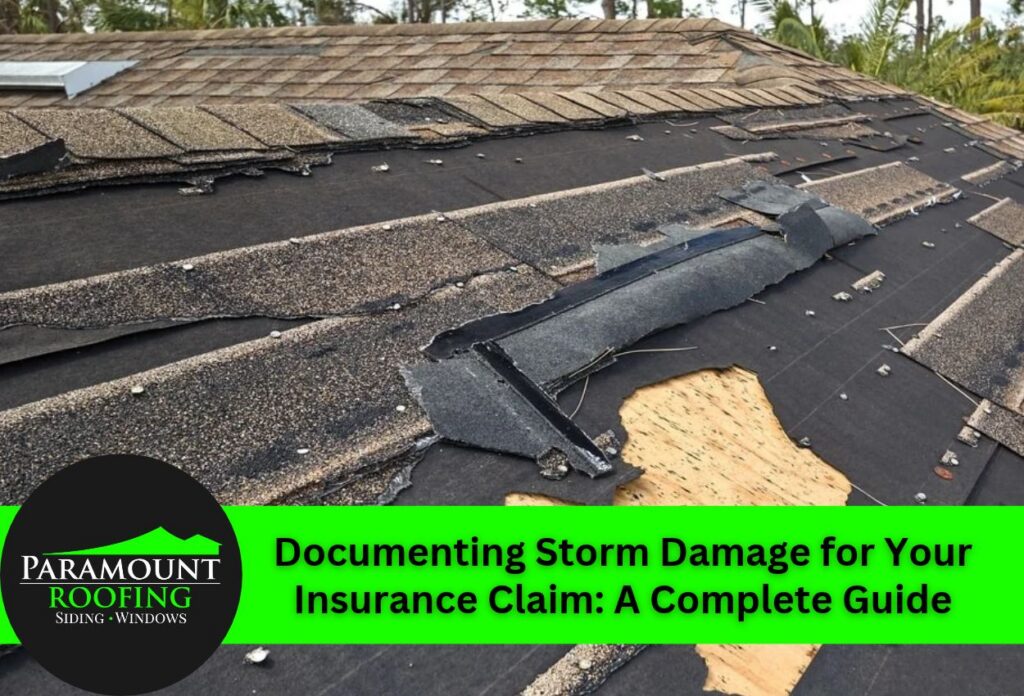

Detroit homeowners should gather dated photos, a written damage log, emergency repair receipts, and a completed insurer loss notice within 24 to 72 hours of a storm. Waiting longer risks claim complications or outright denial. Detroit receives 32 to 36 inches of precipitation annually, plus seasonal hail, ice, and straight-line wind storms strong enough to cause insurance-eligible roof damage. Detroit’s varied weather patterns require immediate documentation to prevent claim denials.
What Should You Photograph First When Documenting Storm Damage for Your Insurance Claim?
Start with wide establishing shots of the full property exterior before moving to any close-up damage. This sequence gives adjusters the context they need to evaluate a claim fairly. Adjusters rely on this spatial context to evaluate structural impact before they look at isolated damage. Each photo zone should produce a minimum of 5 to 10 distinct images.
- Wide establishing shots first: Stand back far enough to capture the entire building from each corner. These images show the property’s condition relative to surrounding structures and mature trees, a detail that matters in Detroit’s densely built neighborhoods.
- Mid-range shots of each roof slope: Photograph every slope separately. South- and west-facing slopes in Detroit take the hardest hits from summer hail, so look for concentrated granule loss on those sides and capture each slope from at least two angles.
- Close-ups of specific damage points: Target missing shingles, cracked or displaced roof flashing, dented gutters, ridge cap displacement, and hail spatter marks on soft metals like aluminum fascia boards or vent caps. Place a measuring tape or common object in the frame so adjusters can judge the scale of the damage.
- Ice dam evidence along eaves: Detroit’s temperature changes create ice dams that can force water under shingles without leaving obvious exterior marks. Photograph the full eave line and any water staining on the soffit or fascia boards below.
- Masonry and brick veneer joints: Many Detroit homes built before 1960 show mortar joint separation after storm stress. Capture any cracked or open joints at a close range from two angles.
- Attic and interior moisture signs: End the sequence inside. Photograph any wet insulation, stained roof decking, or ceiling water marks; these images tie exterior damage directly to interior impact.
Enable metadata in your phone settings so every image carries an automatic timestamp, and shoot only during daylight hours. Taking photos quickly ensures weather-related damage is recorded before conditions change.
What Documentation Do You Need for a Storm Damage Claim Beyond Photographs?
Photos alone are rarely enough; adjusters routinely require additional documentation to process a storm damage claim. Each one fills a gap that photos cannot cover, and together they build a record that is much harder to dispute. For older Detroit homes, this supporting paperwork can affect the final claim value by 20% to 40%.
- Written damage log: Record the storm date, time, storm type (hail, straight-line wind, ice), and every item you observed damaged. Write this within 24 to 72 hours while details are still clear. A handwritten, dated log is acceptable.
- National Weather Service storm records: The National Weather Service Detroit office issues official storm reports that include wind speeds and hail size measurements. Adjusters accept these as third-party verification that the storm actually occurred; request the report for your specific storm date and attach it to your claim file.
- Emergency repair receipts: Save every receipt for tarping, board-up, or temporary weatherproofing. Emergency tarping in the Detroit metro area typically runs $300 to $900. These costs are often reimbursable under your policy’s loss mitigation provisions.
- Pre-storm photos or prior inspection reports: Any dated photos, past inspection reports, or contractor maintenance records from before the storm help establish your roof’s condition at the time of the storm, making it easier to show which damage is new.
- Written estimates from at least two licensed roofing contractors: For older Detroit homes with multiple existing roof layers or aged flashing, a written contractor assessment is especially important. Adjusters closely examine whether damage is storm-caused or pre-existing, and a clear written assessment from a qualified contractor directly addresses that question.
Homes built before 1960 in Detroit are particularly vulnerable to adjuster scrutiny over pre-existing deterioration versus storm damage; a written contractor assessment from a reputable roofer like Paramount Roofing can help document that distinction clearly. Gather all documentation before your adjuster visit.
How Do You File a Storm Damage Claim Without Making Mistakes?
Two steps carry the most weight in any storm damage claim: notifying your insurer within 24 to 48 hours of discovering damage, and holding off on any permanent repairs until after the adjuster has completed their inspection. Missing either one is the fastest way to reduce or lose your payout. The table below maps every step from damage discovery to coverage decision, including the timeframes that matter most.
| Step | Action | Recommended Timeframe | Common Mistake to Avoid |
|---|---|---|---|
| 1 | Document damage with photos, video, and a written log | Within 24 to 72 hours of the storm | Waiting more than 72 hours; photos lose adjuster credibility |
| 2 | Notify your insurer and open a claim | Within 24 to 48 hours of discovery | Delaying notification; many policies have strict reporting windows |
| 3 | Complete only emergency temporary repairs (tarping, board-up) | Within 24 to 48 hours of discovery | Starting permanent repairs before adjuster inspection |
| 4 | Submit written documentation and emergency repair receipts | Within 7 to 14 days of filing | Submitting photos without a written damage log |
| 5 | Schedule adjuster visit | Within 5 to 10 business days of filing | Allowing adjuster to inspect without a contractor present |
| 6 | Get written estimates from at least two licensed contractors | Before or immediately after adjuster visit | Accepting the adjuster’s report without an independent contractor review |
| 7 | Review coverage decision and dispute if incomplete | Within 30 business days of filing | Missing the insurer’s legally required response deadline |
Under Michigan law, insurers must pay claims quickly, typically within 60 days of receiving a satisfactory proof of loss. If your insurer misses this deadline, it becomes a compliance issue you can escalate to the Michigan Department of Insurance and Financial Services. Never begin permanent roof repairs before the adjuster has completed their inspection; doing so gives the insurer grounds to dispute which damage was pre-existing and which was storm-caused, which can cut your settlement amount or void the claim entirely.
What Should You Do After Storm Damage to Get Your Insurance to Pay the Full Amount?
The 5 steps below are ranked by how directly each one affects payout; follow them in order.
- Get a written contractor assessment before the adjuster visits: A licensed contractor’s written report of damage gives you an independent baseline to compare against the adjuster’s findings.
- Have the contractor present during the adjuster inspection: A licensed roofer can point out damage the adjuster might overlook, including flashing failures, granule loss patterns, and soffit damage that photos alone don’t capture well.
- Submit all documentation before the adjuster closes the file: Attach your written damage log, National Weather Service storm records, emergency repair receipts, and at least two written contractor estimates. Missing any one of these gives adjusters room to reduce the settlement.
- Review the adjuster’s report line by line against your contractor estimate: Any missing line items, such as replacement versus repair differences, code-upgrade costs, or interior water damage, should be flagged in writing.
- File a supplemental claim if new damage surfaces during repairs: Contractors sometimes find hidden damage, rotted roof decking, or failed underlayment once tear-off begins. Document it immediately and file a supplemental claim before that work proceeds.
Michigan has AOB restrictions that can complicate or invalidate a claim; never sign over insurance benefits to a contractor before fully understanding what that agreement removes from your control.
How Much Does Underdocumented Storm Damage Cost Detroit Homeowners Compared to a Properly Filed Claim?
Poor documentation frequently forces homeowners to cover thousands in structural repair costs out of pocket rather than just paying their standard deductible. The table below shows exactly what each scenario costs compared to what insurance covers.
| Scenario | Estimated Out-of-Pocket Cost | Estimated Insurance Payout |
|---|---|---|
| Underdocumented claim partial denial | $4,000 to $7,000 | Partial reduced settlement |
| Properly documented claim full approval | $1,000 to $2,500 (deductible only) | Full replacement or repair cost covered |
| Claim denied entirely due to poor documentation | $8,000 to $18,000 (full roof replacement) | $0 |
| Supplemental claim filed after public adjuster review | 10% to 15% of final settlement (adjuster fee) | $2,000 to $6,000 above initial settlement |
Professional documentation support costs far less than most homeowners expect. A contractor residential roof inspection report runs $0 to $250, and a public adjuster charges 10% to 15% of the settlement fees that are typically offset many times over by higher payouts.
Partial denials affect an estimated 30% to 40% of residential storm claims nationally, and homeowners who document systematically are far less likely to land in that group.
Ready to File Your Claim? Here’s How Our Detroit Roofing Team Can Help You Document and Recover Faster.
Delaying your initial documentation allows weather evidence to degrade, making it harder for adjusters to verify new damages. Paramount Roofing provides free storm damage inspections and written assessments that can be submitted directly to your insurance adjuster as supporting documentation. Detroit’s spring and summer storm season drives high claim volume fast, so acting quickly matters.
Paramount Roofing is licensed and insured in Michigan, serving Detroit homeowners ready to move forward. Learn more about our residential storm damage roofing services for Detroit-area homes.
Schedule your free roof inspection.
Not ready to schedule? Learn more about storm damage roofing documentation and recovery.