
 Free Estimate
 Request Service
 Locations
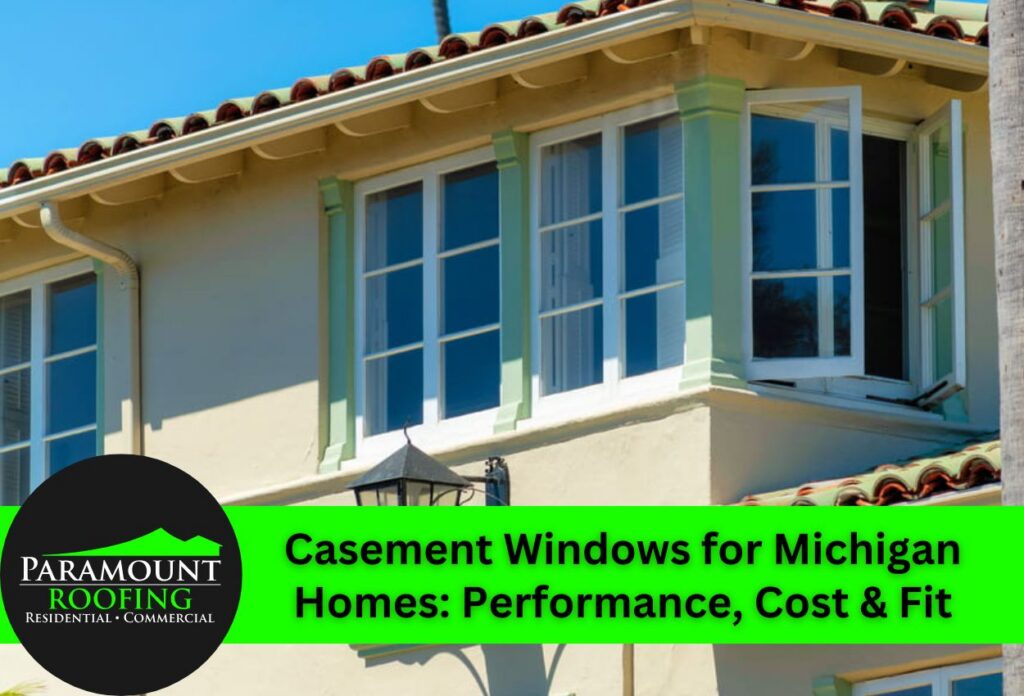

Casement windows are a strong match for Michigan homes. Temperatures in Detroit average at 19 degrees Fahrenheit in January, and combined with a yearly average of 133 days of precipitation, window performance is one of the most important things for a homeowner to consider. Casement windows use a compression seal design that presses the frame tightly against the sash when closed. That design provides stronger air infiltration resistance than sliding windows, with casement units achieving average air leakage rates of 0.30 Cubic Feet per Minute per Square Foot (CFM/ft²) or lower under National Fenestration Rating Council energy performance testing standards.
Detroit’s climate swings hard, going from 84 degrees Fahrenheit summer highs down to single-digit wind chills in winter. With high humidity from the nearby Great Lakes and heavy spring rains, it’s more important for a window to have the ability to seal out air and moisture here than in milder regions.
This article covers energy efficiency, style comparisons, replacement costs, and how to find qualified installation contractors in the Detroit area.
How Do Casement Windows Perform Against Michigan’s Cold Winters?
Casement windows consistently outperform double-hung windows in cold-climate air leakage testing, due to a crank-operated sash that presses directly against the frame to form a compression seal when closed. That seal tightens with every turn of the crank, leaving almost no gap for cold air or moisture to push through.
Detroit’s position near the Great Lakes brings elevated humidity year-round and puts window frames through repeated temperature swings that wood cannot handle as well as vinyl and fiberglass. These frames maintain their shape and seal across a temperature range of -40°F to 180°F, making them far more reliable than wood frames in this climate. Wood frames absorb moisture, swell, and shrink with Detroit’s seasonal extremes. Vinyl and fiberglass hold their dimensions and keep the compression seal working as intended. That stability matters most during the freeze and thaw cycles that run from late fall through early spring.
Michigan Building Code requires windows to comply with the International Energy Conservation Code (IECC). Detroit is in Climate Zone 5A, which has requirements of a U-factor of 0.32 or lower. The U-factor measures how much heat escapes through the glass, with lower numbers meaning better insulation. A casement unit with double-pane glass and a qualifying frame can meet both requirements while reducing heating and cooling strain throughout the year.
Are Casement Windows Better than Double-Hung Windows for Detroit Homes?
Casement windows perform better than double-hung windows in cold weather, with lower air leakage rates and better U-factors, giving them a performance edge that matters when January lows average 19 degrees Fahrenheit in Detroit.
| Feature | Casement Window | Double-Hung Window |
|---|---|---|
| Air Leakage Rate (CFM/ft²) | 0.30 or lower | 0.20 to 0.30 |
| Typical U-Factor Range | 0.17 to 0.32 | 0.25 to 0.35 |
| Average Lifespan (years) | 20 to 40 years | 15 to 30 years |
| Ventilation Control | Up to 100% of frame area | Up to 50% of frame area |
| Cold-Climate Suitability | Strong air leakage resistance, ideal for cold environments | Cold air passes through more easily, less ideal |
Double-hung windows are more commonly seen in Detroit homes that were built before 1950, which makes up a large share of the city’s residential properties. Casement windows are more common in newer Michigan constructions. The ventilation gap is the most overlooked difference, with casement windows opening up to 100% of the frame area versus just 50% for double-hung, which matters during Detroit’s humid summers when air circulation is needed. For homeowners replacing older windows in aging Detroit homes, switching to casement-style units can improve both summer airflow and winter sealing in one upgrade.
What Does Casement Window Replacement Typically Cost in Michigan?
Installed casement window costs in the Detroit area can range from roughly $300 to over $1,450 per window depending on frame material, with fiberglass and wood units sitting at the higher end of that range.
| Frame Material | Avg. Unit Cost (Materials Only) | Avg. Labor Cost per Window (Detroit) | Avg. Total Installed Cost per Window |
|---|---|---|---|
| Vinyl | $150 to $400 | $150 to $250 | $300 to $650 |
| Fiberglass | $400 to $900 | $175 to $300 | $575 to $1,200 |
| Aluminum | $300 to $700 | $150 to $275 | $450 to $975 |
| Wood | $500 to $1,100 | $200 to $350 | $700 to $1,450 |
Permit costs add to the total only when a structural opening is being changed. Replacements that aren’t changing the original style of the window typically do not require a permit in Detroit, but any change to the opening size requires approval through the Buildings, Safety, Engineering, and Environmental Department (BSEE). If a permit is required, fees will vary based on project size. Vinyl casement windows deliver the lowest installed cost while still meeting Detroit’s Zone 5A requirements, making them the most budget-friendly path to a qualifying U-factor of 0.32 or lower. For scheduling, the best installation window runs from late May through early October. Booking during peak summer, June through August, can push contractor lead times 3 to 6 weeks longer than spring or fall scheduling.
Homeowners looking to manage upfront project costs can also explore window replacement financing options to spread payments over time.
Which Type of Casement Window Is Most Energy Efficient for Michigan Homes?
Triple-pane casement windows with a U-factor of 0.32 or lower deliver the best energy performance for Michigan homes, and can reduce heating energy loss through glass by up to 50% compared to standard double-pane units. This is a meaningful difference during Detroit’s roughly 6-month heating season running November through April.
- U-factor of 0.32 or lower: This is the minimum requirement for the IECC in Detroit’s Zone 5. Lower numbers mean less heat escapes through the glass. Casement windows commonly reach U-factors as low as 0.17, well below the Zone 5A cutoff.
- Low-E double-pane or triple-pane glass: Low-E coating reflects indoor heating into the room during winter while preventing summer heat from passing through. Triple-pane units push performance further with up to 50% reduction in heating energy loss through glass, making them worth considering for homes with large window openings or north-facing exposures.
- Argon or krypton filling: Modern windows fill the cavities between the glass with stable gases to prevent heat transfer. Argon gas between panes slows heat transfer better than air alone, while Krypton performs even better in thinner spaces but costs more. Both outperform air-filled units in cold-climate applications and are standard in most ENERGY STAR-rated casement windows.
- Warm-edge spacer systems: The spacer holds the glass panes apart at the edges. Warm-edge spacers reduce condensation and heat loss along the glass border, a detail that matters in Detroit’s cold winters.
ENERGY STAR-certified casement windows qualify for a federal tax credit up to 30% of product cost, capped at $600 per year. This gives Michigan homeowners a concrete financial reason to upgrade from older single-pane units. Pairing a qualifying U-factor with an argon or krypton gas filling and a warm-edge spacer system maximizes that credit while targeting the features that matter most in Detroit’s climate.
Do Casement Windows Add Value and ROI for Detroit Homeowners?
Window replacement returns approximately 63% to 76% of project costs at resale nationally, according to the Journal of Light Construction Cost vs. Value report. Upgrading to ENERGY STAR-rated casement windows in a cold climate can save you $200 to $600 per year on top of that, depending on where you live, how many windows are replaced, and the condition of the existing units.
| Value Factor | Casement Window Performance | Comparison Baseline |
|---|---|---|
| Resale ROI (national average) | Approximately 63% to 76% of project cost | Varies by material and market |
| Annual energy savings (cold climate) | $200 to $600 per year | Single-pane or aging aluminum units |
| Frame warranty (vinyl/fiberglass) | Typically 20 to 30 years | Aluminum single-pane: 15 to 20 years |
| Glass seal warranty | Typically 10 to 20 years | Older units may have little to no coverage |
Quality vinyl and fiberglass casement windows can carry manufacturer warranties of 20 to 30 years on frames and 10 to 20 years on glass seals. That is longer than the typical aluminum single-pane window, which averages 15 to 20 years before seals fail and frames degrade. The replacement decision is not just about curb appeal. It is a long-term investment backed by documented resale return, lower energy costs, and a warranty that outlasts the window it replaces.
Ready to Upgrade? Find Qualified Casement Window Contractors in Detroit
Switching to ENERGY STAR-rated casement windows can return 63% to 76% of project costs at resale while saving $200 to $600 on annual heating and cooling energy costs, but only when the installation is done right by a licensed contractor. In Detroit, contractors performing exterior window work may need to hold a valid State of Michigan residential builder license and comply with BSEED permitting requirements. Paramount Roofing serves homeowners in the Detroit area and can help confirm what licensing and permit steps apply to your project.
Scheduling from late spring through early fall gives the best installation conditions in Michigan’s climate. Request a free in-home estimate to get started.
Request your free estimate today
Not ready to schedule? Learn more about casement window replacement.