
 Free Estimate
 Request Service
 Locations
Key Points:
- Self-healing shingles are advanced roofing materials that automatically repair minor damage like cracks and punctures using sunlight-activated polymers.
- These innovative shingles offer an extended lifespan, significantly reduced maintenance, and long-term savings by continuously repairing themselves.
- Activated by solar heat, they effectively seal small defects, providing superior durability and enhanced weather protection compared to traditional roofing options.
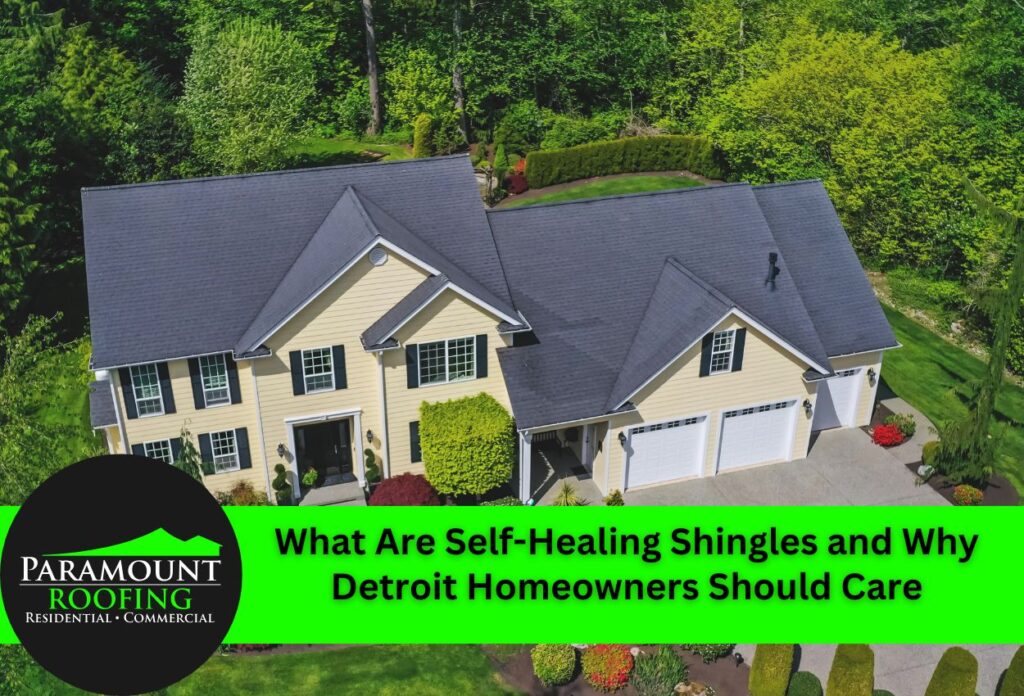
Self-healing shingles represent a revolutionary advancement in roofing technology that automatically repairs minor damage without requiring professional intervention. These innovative self-healing asphalt shingles contain specialized polymers and advanced materials that respond to heat and weather conditions by sealing small cracks, punctures, and weathered areas on their own.
How self-healing shingles work involves a sophisticated process where the shingle material becomes temporarily flexible when exposed to sunlight and moderate temperatures, allowing damaged areas to naturally close and bond back together. This self-healing technology activates repeatedly throughout the shingle’s lifespan, continuously maintaining the roof’s protective barrier. Manufacturers design these shingles to seal microcracks from thermal movement, not major impacts, meaning routine inspections remain necessary to address storm damage beyond the material’s self-repair capability over time reliably.
For Detroit homeowners, comparing self-healing shingles and traditional shingles can give interesting insights into the best materials for their homes, given Michigan’s harsh weather patterns. The region’s extreme temperature fluctuations, heavy snow, ice dam formation, and severe storms create conditions where minor roof damage frequently occurs.
This roofing innovation addresses the constant battle between Michigan’s climate and traditional roofing materials, offering homeowners a proactive solution that works around the clock to maintain roof integrity.
The Science Behind How Self-Healing Shingles Actually Work
Self-healing shingles utilize advanced polymer compounds embedded within modified asphalt formulations that create their remarkable repair capabilities. These specialized polymers remain dormant in normal conditions but activate when exposed to solar heat, typically requiring temperatures between 70 and 85 degrees Fahrenheit. The polymer matrix contains thermoplastic materials that soften and become pliable when heated, allowing them to flow into small cracks and punctures automatically.
When sunlight warms the shingle surface, the asphalt-based materials soften slightly, reducing stiffness within the shingle layer. This softening allows minor surface cracks or small punctures to relax and close, sealing themselves to the elements.
Once temperatures cool, the polymer solidifies again, creating a permanent seal that restores the shingle’s protective barrier. This process can repeat countless times throughout the shingles’ lifespan, making self-healing shingles particularly effective for addressing ongoing wear from weather exposure and thermal cycling that commonly affects roofing systems.
Key Advantages Self-Healing Shingles Offer Over Standard Roofing Materials
Self-healing shingles provide significant advantages over traditional roofing materials through their automatic repair capabilities and enhanced durability features. These benefits of self-healing shingles translate into extended lifespans that often exceed conventional asphalt shingles.
The reduced maintenance requirements stem from the shingles’ ability to address small cracks, punctures, and weather-related wear automatically. Property owners experience fewer emergency repairs and less frequent roof inspections compared to standard materials. Self-healing asphalt shingles maintain their protective qualities longer, reducing the frequency of partial roof replacements that commonly occur with traditional systems.
Long-term savings become apparent through decreased professional repair needs and extended replacement cycles. The self-healing roof technology also contributes to improved energy efficiency by maintaining better seals over time. When comparing self-healing shingles to traditional shingles, the automatic maintenance aspect eliminates many routine repair expenses while preserving the roof’s protective performance throughout changing seasons and weather conditions.
Understanding Self-Healing Asphalt Shingle Composition and Materials
Self-healing asphalt shingles incorporate specialized formulas that distinguish them significantly from conventional roofing materials. The base asphalt mixture contains enhanced polymer additives, including thermoplastic compounds and advanced elastomers that create the healing properties. These embedded healing agents remain stable during normal weather conditions but activate when temperatures reach the right ranges for the repair processes to begin.
The manufacturing process involves precise integration of healing polymers throughout the asphalt matrix, ensuring consistent distribution and performance reliability. Quality control standards require extensive testing across various climate conditions to verify that the healing agents maintain effectiveness through extreme temperature variations, humidity changes, and UV exposure typical in regions like Michigan.
Advanced manufacturing techniques create a uniform distribution of particles within each shingle, preventing healing agent clustering that could compromise performance. The specialized asphalt formulations undergo rigorous durability testing to ensure the self-healing roof technology functions reliably across multiple cycles. These quality standards guarantee that the self-healing shingles work consistently, whether they are facing summer heat waves or winter freeze-thaw cycles, providing reliable performance throughout the product’s extended lifespan.
Revolutionary Roof Technology Features That Set These Shingles Apart
Self-healing shingles incorporate cutting-edge weatherproofing capabilities that far exceed traditional roofing materials through multiple advanced protection systems. These innovative shingles demonstrate exceptional wind uplift resistance, engineered to withstand sustained high winds while maintaining structural integrity. The self-healing roof technology includes specialized reinforcement fibers that prevent delamination during severe weather.
Enhanced hail resistance comes from impact-absorbing polymer compounds that cushion strikes from hailstones while triggering immediate healing responses to seal any surface damage. The shingles’ UV degradation protection involves advanced stabilizers that prevent color fading and material breakdown from prolonged sun exposure, maintaining both appearance and functionality throughout their extended lifespan.
Smart material properties enable these self-healing asphalt shingles to respond dynamically to environmental conditions. The embedded polymers automatically adjust their viscosity based on the temperature, becoming more flexible during thermal expansion and firming during cold contractions. This adaptive behavior prevents common roofing failures like thermal splitting, granule loss, and edge lifting that frequently plague conventional systems. The intelligent material response creates a roofing system that continuously optimizes its protective performance regardless of seasonal weather variations.
Performance Comparisons Between Self-Healing and Traditional Shingles
Extensive durability testing reveals significant performance advantages when comparing self-healing shingles and traditional shingles across key metrics. Laboratory tests that accelerated wear and tear demonstrate that self-healing asphalt shingles maintain their original flexibility after 25 years.
Weather resistance improvements become evident through standardized impact tests, where self-healing materials demonstrate superior recovery from hail damage and thermal stress cracking. They may reduce the frequency of minor repairs compared to standard shingles, though results vary by climate and installation.
The differences in maintenance requirements highlight practical homeowner advantages, with self-healing systems needing routine inspections every few times every couple of years compared to the two annual checks recommended for conventional shingles. The benefits of self-healing shingles extend to reduced granule loss and improved seal retention around fasteners and edges. These performance improvements translate into measurable cost savings through its extended service life and decreased emergency repair frequency, making the technology particularly valuable for homeowners seeking long-term roofing solutions.
Making the Right Choice for Your Detroit Area Home
Selecting self-healing shingles requires a close look at specific factors that determine compatibility with individual roofing situations. Climate suitability becomes particularly important since these shingles require adequate thermal activation cycles to maintain their healing properties effectively. Michigan’s temperature variations generally provide good conditions for self-healing shingles, though extreme cold periods may temporarily reduce the healing activity.
Roof structure assessment proves essential before installation, as self-healing asphalt shingles typically weigh slightly more than traditional materials. The existing condition of the roof deck, rafter spacing, and overall structural integrity must support the enhanced weight distribution. Installation requirements demand experienced contractors familiar with self-healing roof technology specifications, including proper fastener placement and sealing techniques that maximize healing effectiveness.
Questions to ask potential contractors should focus on their specific experience with self-healing systems, available product warranties, and realistic performance expectations for your roof configuration. Understanding warranty coverage differences between self-healing shingles and traditional shingles helps ensure proper protection for your investment while establishing clear performance benchmarks for expected benefits of self-healing shingles over time.
Discover Paramount Roofing’s Advanced Self-Healing Shingles in Detroit
Are you a Detroit homeowner intrigued by the latest advancements in roofing technology? Paramount Roofing is proud to introduce self-healing shingles, designed to withstand Michigan’s notorious weather extremes. These innovative shingles utilize cutting-edge materials that automatically repair minor damages caused by temperature fluctuations and severe weather conditions, ensuring prolonged durability and superior protection for your home.
With self-healing shingles, you can enjoy significant savings on maintenance and repair costs over time while enhancing your home’s energy efficiency. Their ability to self-repair minor punctures and cracks not only extends the lifespan of your roof but also maintains its curb appeal without continual upkeep.
If you’re considering upgrading your roofing system, don’t wait. Give Paramount Roofing a call now at (586) 690-0227 to learn more about how our self-healing shingles can benefit your Detroit home. Choose smart, durable roofing. Choose Paramount Roofing.