 Free Estimate
 Request Service
 Locations
What Are the Best Roofing Materials for Pole Barn Roofs in Detroit, MI?
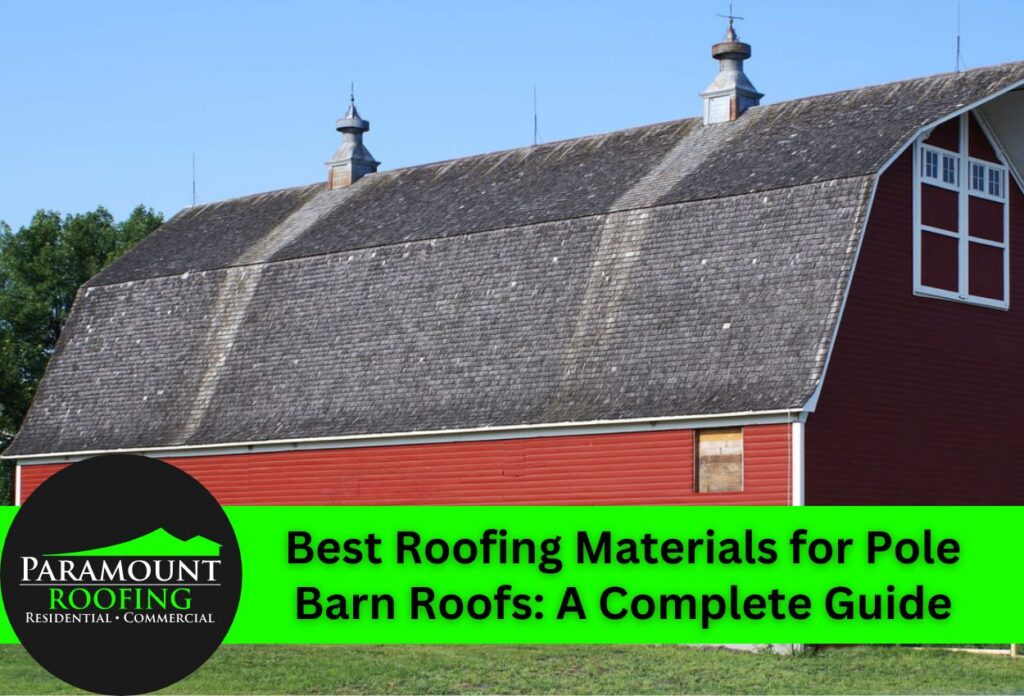

Metal roofing systems, specifically ribbed steel panels and standing seam, cover an estimated 70% to 80% of new post-frame builds across the Midwest, making them the dominant choice for pole barn roofs in Detroit. That advantage comes down to performance: metal handles heavy snow, sheds ice quickly, and holds up through repeated temperature changes that would wear down lesser materials.
Detroit adds its own set of demands. The city sees around 40 inches of snowfall each year, summer humidity regularly topping 70%, and seasonal temperature swings that can crack or degrade materials not built for those conditions. That combination eliminates options like roll roofing and pushes most pole barn owners toward metal or membrane systems.
*Please note, price ranges listed in this article may not reflect the final cost of your project. Prices are subject to change based on various factors such as local labor rates, material quality, and more. All costs established in this article are rough estimates based on average industry rates.
How Do the Top Pole Barn Roofing Materials Compare in Performance and Durability?
Standing seam metal is the most durable roofing material for agricultural buildings, lasting 40 to 70 years with an Excellent freeze-thaw resistance rating, outperforming every other option in this comparison. The table below shows how all four materials stack up across the metrics that matter most for Detroit pole barn owners.
| Material | Lifespan (years) | Snow Weight Rating (psf) | Minimum Roof Slope | Freeze-Thaw Resistance |
|---|---|---|---|---|
| Ribbed Steel Panels | 25 to 40 years | 20 to 40 psf | 1:12 | Good |
| Standing Seam Metal | 40 to 70 years | 40+ psf | 1:12 | Excellent |
| Asphalt Shingles | 20 to 30 years | Varies | 2:12 | Fair |
| TPO/EPDM Membrane | 15 to 25 years | Varies | 0.25:12 min | Good |
Michigan Building Code sets Detroit’s ground snow weight at approximately 20 psf. Any material without a confirmed rating at or above that threshold requires structural reinforcement, adding cost and complexity to the build. Ribbed steel panels with a 20 psf minimum rating meet Detroit’s threshold at the low end, while standing seam’s 40+ psf rating provides a meaningful safety margin above the required minimum. Asphalt shingles carry the weakest temperature-change resistance of the group, making them a short-term solution in a climate that demands more.
What Makes Standing Seam Metal Roofing Systems the Top Choice for Pole Barns?
Standing seam metal roofing systems for pole barns outperform ribbed panels primarily because their concealed fastener design eliminates exposed screw holes, the source of most metal roof leaks over time. Ribbed panel systems drive fasteners through the metal face, leaving hundreds of gaps that degrade as the panels expand and contract with temperature changes. Those systems typically require re-screwing every 10 to 15 years to stop leaks from developing. Standing seam panels interlock at raised seams, with fasteners hidden beneath the overlapping metal, meaning no exposed holes, no washers to dry rot, and no scheduled re-fastening.
Low-Slope Compatibility
Standing seam works on roof slopes as low as 1:12, which covers the low-pitch designs common on Detroit-area pole barns. That flexibility alone makes it the practical choice for agricultural and storage builds where headroom or framing costs push designers toward flatter rooflines. Our residential metal roofing systems services include standing seam systems with manufacturer warranties typically running 30 to 40 years, compared to 25 to 40 years for ribbed panels, a meaningful gap when the goal is a roof that outlasts the building loan.
Condensation Control in Detroit’s Climate
Detroit summers regularly push relative humidity above 70%, and unventilated pole barns trap that moisture under the roof deck. Pairing standing seam with a breathable, vapor-permeable underlayment reduces moisture buildup that causes mold and rot, a problem that quietly destroys roof decks in tightly sealed agricultural structures. A non-breathable underlayment traps vapor against the roof decking, accelerating decay. The breathable wrap allows moisture to move out rather than accumulate, protecting the structure across Detroit’s humid months and through the freeze-thaw temperature changes of fall and spring.
What Does It Cost to Roof a Pole Barn in Detroit, MI?
Pole barn roof replacement options and costs in Detroit range from $7,200 for basic asphalt shingles up to $28,800 for standing seam metal on a standard 2,400 square foot barn, a spread that reflects both material differences and Detroit labor rates running 10% to 15% above national averages.
| Material | Installed Cost per Sq Ft | Cost for 2,400 Sq Ft Barn | Estimated Lifespan |
|---|---|---|---|
| Ribbed Steel Panels | $3.50 to $5.50 | $8,400 to $13,200 | 25 to 40 years |
| Standing Seam Metal | $7.00 to $12.00 | $16,800 to $28,800 | 40 to 70 years |
| Asphalt Shingles | $3.00 to $5.00 | $7,200 to $12,000 | 20 to 30 years |
| TPO/EPDM Membrane | $4.50 to $7.00 | $10,800 to $16,800 | 15 to 25 years |
Michigan permit fees for roofing projects typically add $150 to $400 on top of installation costs, depending on the municipality and project scale, a line item easy to overlook during budgeting. Standing seam metal costs roughly twice as much upfront as asphalt shingles, but its 40- to 70-year lifespan means fewer replacements over the life of the building, making it the stronger long-term value for most Detroit pole barn owners.
Schedule any replacement between May and September. Cold-temperature adhesive failures and winter installation restrictions make work outside that window unreliable and potentially code-non-compliant. Paramount Roofing can help determine the right material and timing for your specific build. If upfront costs are a concern, explore roofing financing options to spread the investment across manageable payments.
How Do You Choose the Right Roofing Material for a Pole Barn Based on Use Case?
Choosing the right roofing material for a pole barn comes down to five measurable criteria, starting with roof slope, which eliminates options before budget or lifespan even enter the conversation.
- Roof slope: Confirm the existing slope before selecting any material. This is the first step in knowing how to choose roofing material for a pole barn. Standing seam and ribbed panels require a 1:12 minimum slope; asphalt shingles need at least 2:12; TPO/EPDM membrane systems work on slopes as low as 0.25:12. Installing the wrong material on a mismatched slope voids most manufacturer warranties.
- Intended use: Livestock and agricultural barns generate moisture from animal respiration and feed storage. Those structures need breathable wraps to allow vapor to escape rather than accumulate against the roof deck. A standard residential approach will trap humidity and accelerate wood rot in agricultural environments.
- Snow weight: Michigan sets the minimum ground snow weight at 20 psf for the Detroit area. Verify that the structural framing meets that threshold before selecting any material, heavier options like standing seam require framing rated to handle that weight without added reinforcement costs.
- Budget horizon: If the plan is to replace the roof within 15 years, ribbed panels at $3.50 to $5.50 per sq ft installed are an acceptable fit. If the goal is holding the building for 40 years or longer, standing seam at $7.00 to $12.00 per sq ft delivers lower lifetime cost despite the higher upfront investment.
- DIY vs. contractor installation: Ribbed panels are DIY-viable for experienced builders and represent one of the most accessible metal roofing systems for post-frame buildings in terms of installation. Standing seam requires professional installation, proprietary seaming equipment, and precise technique, making it impractical without trained crews.
One additional factor applies to enclosed, conditioned pole barns: Michigan Energy Code may require continuous insulation (CI), which affects how materials layer over the roof deck and can add $0.75 to $1.50 per sq ft to total project costs. Our residential roofing insulation services can help ensure your pole barn meets Michigan Energy Code requirements before finalizing any material selection. Confirm insulation requirements with a local building department or licensed contractor before finalizing any material selection.
Which Pole Barn Roofing Material Delivers the Best Long-Term Value in Michigan?
Standing seam metal delivers a near-equivalent or better 30-year total cost compared to ribbed steel panels despite costing roughly twice as much upfront on a 2,400 sq ft barn. Ribbed steel starts lower, but scheduled maintenance and likely replacement push its 30-year total above $24,000. Standing seam at $22,800 installed requires no re-screwing and no replacement within that same window.
| Material | Initial Install | Maintenance (30 yr) | Replacement Needed? | 30-Yr Total |
|---|---|---|---|---|
| Ribbed Steel Panels | $10,800 | About $3,000 (re-screwing at year 12) | Yes, likely at year 28 | $24,000+ |
| Standing Seam Metal | $22,800 | Minimal re-screwing required | No | $22,800 to $24,000 |
Remodeling industry benchmarks show metal roofing systems on agricultural structures can increase property resale value by 5% to 7%. A standing seam installation may also qualify for Michigan agricultural property tax classifications that recognize capital improvements as a financial benefit, worth confirming with a local tax assessor before finalizing material selection.
When holding a property for 25 years or longer, standing seam’s lower lifetime cost and 40- to 70-year lifespan make it the stronger financial choice for Detroit-area pole barn owners. Paramount Roofing can help you run the numbers for your specific building before committing to either option.
Ready to Replace or Install a Pole Barn Roof in Detroit? Here’s How to Get Started.
Avoiding an expensive mid-winter emergency or a failed inspection that delays your project starts with one phone call before May. Accurate material and cost recommendations for a pole barn roof require an on-site slope measurement, snow weight assessment, and structural inspection. No quote over the phone can replace that. Paramount Roofing serves Detroit-area pole barn owners and can confirm Michigan permit requirements and energy code compliance as part of the quoting process, removing that paperwork burden from your side.
If storm damage has compromised your current roof, our emergency roofing services are available to address urgent repairs before the installation window opens. The installation window runs from May through September: booking early locks in your spot before the season fills.
Schedule your free roof estimate.
Not ready to schedule? Learn more about metal roofing systems for pole barns.