
 Free Estimate
 Request Service
 Locations

What Is the Best Attic Insulation for Detroit Homes in Michigan’s Cold Climate?
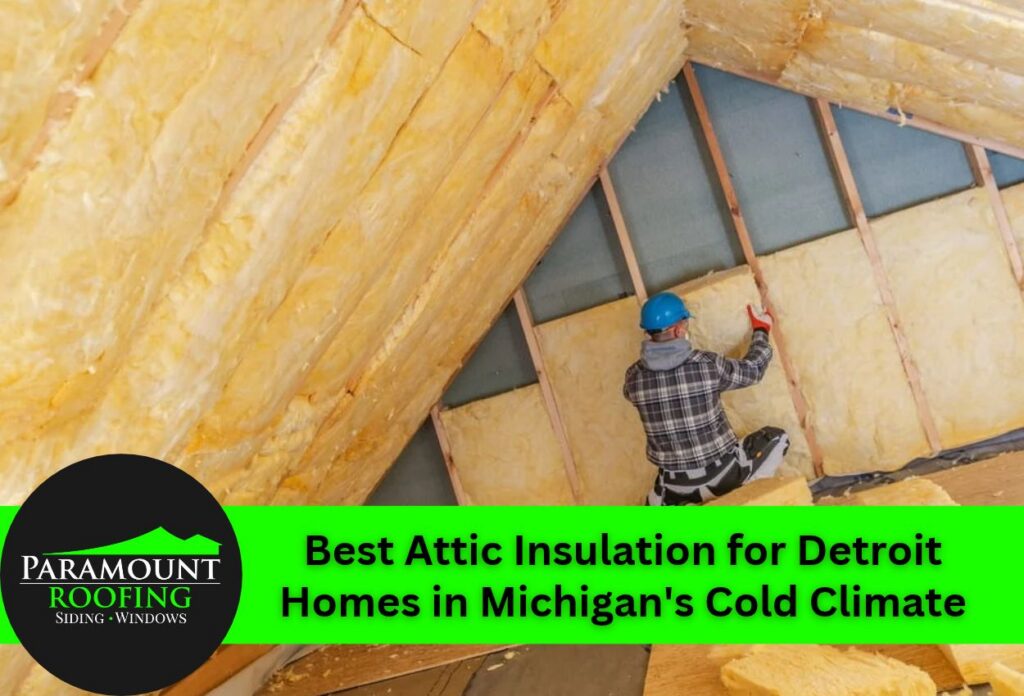

Michigan’s climate zone (Zone 5) requires a minimum attic insulation R-value of R-49 under the current residential energy code, and most Detroit homes built before 1980 fall well below that threshold. That gap means higher heating bills, cold spots near ceilings, and added stress on the roof assembly every winter.
For Detroit’s combination of cold winters with average January lows near 20 degrees Fahrenheit and winter relative humidity reaching up to 74%, blown-in cellulose and blown-in fiberglass are the top-performing materials. Both handle temperature swings well and fill irregular attic spaces without gaps. Spray foam is the premium choice for older, air-leaky homes where sealing and insulating happen at the same time.
What R-Value Does Detroit Attic Insulation Need to Meet Michigan Energy Code?
For existing homes undergoing upgrades, the minimum requirement drops to R-38. However, ENERGY STAR recommends pushing to R-60 for homes aiming to maximize thermal efficiency and permanently lower utility costs.
The gap between code and reality is wide in Detroit. Most pre-1970 wood-frame homes, and there are many of them throughout the city, typically have only R-11 to R-19 of existing insulation. That means the average older Detroit home needs to add R-30 or more just to reach the minimum upgrade threshold, and even more to hit the R-49 new construction standard. Low insulation levels like these translate directly into higher heating costs every winter, especially during the stretches of cold that push January temperatures down to around 20 degrees.
Unvented Attic Assemblies Under Michigan Code
Michigan code does allow an alternative path for homeowners who want an unvented attic assembly. Under this approach, closed-cell spray foam is applied directly to the underside of the roof deck, pulling the attic fully inside the building’s thermal layer. The code requires a minimum of R-20 closed-cell spray foam at the roof deck for this pathway to qualify. This option works well for older homes with complex framing or air-sealing problems that standard blown-in insulation cannot fully address on its own.
How Do the Top Attic Insulation Materials Compare for Detroit’s Winter Conditions?
Closed-cell spray foam delivers the highest R-value per inch at R-6.0 to R-6.5, but blown-in cellulose is the most practical choice for the majority of Detroit’s older wood-frame attics that need volume fill to reach R-49. Our residential roofing insulation services cover all major blown-in and spray foam options for Michigan homes.
| Material | R-Value per Inch | Air-Sealing Capability | Moisture Resistance | Installed Depth to Reach R-49 | Suitability for Detroit Older Wood-Frame Homes |
|---|---|---|---|---|---|
| Blown-In Fiberglass | R-2.2 to R-2.7 per inch | Partial | High | 18 to 22 inches | Good |
| Blown-In Cellulose | R-3.2 to R-3.8 per inch | Partial | Medium | 13 to 15 inches | Excellent |
| Open-Cell Spray Foam | R-3.5 to R-3.7 per inch | Yes | Low | 13 to 14 inches | Fair |
| Closed-Cell Spray Foam | R-6.0 to R-6.5 per inch | Yes | High | 7 to 8 inches | Good |
Blown-in cellulose reaches R-3.2 to R-3.8 per inch and is treated for fire and pest resistance, a real advantage in Detroit’s dense older neighborhoods where wood-frame construction is common. Closed-cell spray foam needs the least installed depth at just 7 to 8 inches to hit R-49, but carries a higher cost per square foot than blown-in options. For vented attics that simply need volume fill to reach R-49, blown-in cellulose or fiberglass is the standard recommendation, while closed-cell spray foam is the better fit for unvented assemblies or older pre-1960 Detroit homes with significant air bypasses around chimneys, knee walls, or duct gaps that blown-in materials alone cannot fully seal.
What Does It Cost to Insulate an Attic in Detroit, Michigan?
Attic insulation in Detroit runs from about $1.50 to $2.50 per square foot installed for blown-in options, up to $6.00 to $8.00 per square foot for closed-cell spray foam, making material choice the single biggest cost driver for most homeowners.
| Material | Material Cost per Sq Ft | Labor Cost per Sq Ft | Total Installed Cost per Sq Ft | Estimated Total for 1,000 Sq Ft Attic |
|---|---|---|---|---|
| Blown-In Fiberglass | $0.75 to $1.25 | $0.50 to $1.00 | $1.25 to $2.25 | $1,250 to $2,250 |
| Blown-In Cellulose | $1.00 to $1.50 | $0.50 to $1.00 | $1.50 to $2.50 | $1,500 to $2,500 |
| Open-Cell Spray Foam | $1.50 to $2.00 | $0.75 to $1.25 | $2.25 to $3.25 | $2,250 to $3,250 |
| Closed-Cell Spray Foam | $4.00 to $6.00 | $1.50 to $2.50 | $6.00 to $8.00 | $6,000 to $8,000 |
Securing the building against drafts is strongly recommended in older wood-frame homes, and most reputable contractors require it to maintain warranty coverage. Expect this preliminary weatherization step to influence the overall project budget. Detroit-area homeowners can offset some of these costs through Michigan’s Home Heating Credit and DTE Energy or Consumers Energy rebates of up to $300 to $500 for qualifying attic insulation upgrades. Even with air-sealing added, blown-in cellulose remains the lowest-cost path to reaching R-49 for most vented attics. Homeowners looking to manage upfront project costs may also want to explore financing options for home improvement projects.
Which Attic Insulation Is Right for Your Detroit Home’s Specific Situation?
Choosing the right material for cold Michigan winters depends entirely on your home’s age, existing insulation levels, attic type, and air-leakage history; there is no universal solution. Match your situation to one of the five scenarios below to find the right starting point.
- Older home with no existing insulation and an accessible attic hatch: Blown-in cellulose is the go-to choice here. It fills irregular joist bays and brings the assembly up to R-49 at a depth of 13 to 15 inches, the lowest-cost path to code compliance for most Detroit wood-frame homes.
- Home with existing fiberglass batts below R-19: Add blown-in fiberglass over the existing batts to reach R-49. This approach avoids tearing out older material and keeps total installed costs in the $1.25 to $2.25 per square foot range.
- Unvented or cathedral ceiling attic: Closed-cell spray foam applied directly to the roof deck is the only practical option. Michigan code requires a minimum of R-20 closed-cell spray foam at the roof deck for this assembly to qualify as an unvented system.
- Home with an ice dam history or significant air leakage around chimneys and duct boots: Air-seal every gap first; expect to add $300 to $700 to the project total, then follow with blown-in cellulose to reach R-49. Insulation without air-sealing will not stop ice dams. Homeowners dealing with ice dam damage should also review residential storm damage roofing services to assess whether the roof assembly has been compromised.
- Buyer of a Detroit home with an unknown insulation history: Schedule a thermal imaging assessment before selecting any material. Hidden gaps and uneven coverage are common in older Detroit housing and will affect both material choice and total project cost.
As noted earlier, pre-1940 balloon-frame construction acts like a chimney, pulling warm interior air from the basement straight up into the roof assembly. Bypassing the sealing process here renders even premium insulation practically useless against freezing temperatures.
How Much Can Better Attic Insulation Save Detroit Homeowners on Energy Bills?
The U.S. Department of Energy estimates that properly air-sealing and insulating an attic can reduce heating and cooling costs by 10% to 20% annually. For a Detroit home with average gas heating costs of $900 to $1,200 per winter season, that translates to $90 to $240 in real savings every year.
Those numbers make more sense when you run a simple payback calculation. A blown-in cellulose project installed for $2,000 reduced to a net cost of $1,600 after a $400 utility rebate saves roughly $180 per year on average. At that rate, the project pays for itself in about 8 to 9 years. Since blown-in cellulose lasts 20 to 30 years, that leaves 11 to 22 years of net positive return after the payback point is reached. That payback window makes attic insulation one of the higher-return home upgrades available to Detroit homeowners.
The savings potential is not the same across every home. Older Detroit neighborhoods, particularly pre-1960 housing with R-values below R-19, as noted earlier, tend to see savings closer to the 20% end of the range. The larger the gap between existing insulation and code-level performance, the more room there is for measurable improvement once that gap is closed.
Stacking available rebates from DTE Energy or Consumers Energy with Michigan’s Home Heating Credit can reduce the net project cost further, shortening the payback period and improving the long-term return even more.
Ready to Upgrade Your Attic Insulation in Detroit? Here’s How to Get Started.
With payback periods as short as 8 to 9 years and annual savings of $90 to $240 on heating costs, the window before Detroit’s winter heating season is the best time to act. Paramount Roofing works with Detroit-area homeowners to evaluate existing R-values, identify air-sealing needs, and recommend the right material for each home with no obligation required.
Schedule your free attic assessment before cold temperatures arrive and start losing heat through an under-insulated roof assembly.
Not ready to schedule? Learn more about attic insulation services.