 Free Estimate
 Request Service
 Locations
Best Roofing Materials for Michigan Homes: Snow, Ice & Durability Guide

Detroit roofs must handle the weight of snow at 20 pounds per square foot, wind gusts up to 90 mph, and around 34 inches of annual precipitation, conditions that make choosing the right roofing material far more consequential than in milder parts of the country. The best roofing materials for Michigan homes are not the same ones that work fine in Georgia or Arizona. Here, the wrong choice can mean ice dams, structural stress, and a roof that fails years ahead of schedule.
This article breaks down the four materials best suited for Detroit’s climate: architectural asphalt shingles, which balance cost and cold-weather performance, metal roofing, which sheds snow fast and lasts up to 70 years, slate, which can protect a home for 75 to 200 years, and EPDM rubber roofing, which handles low-slope roofs through Michigan’s harshest seasons.
Each section covers lifespan, climate performance, and cost so Detroit homeowners can make a confident, informed decision.
*Please note, price ranges listed in this article may not reflect the final cost of your project. Prices are subject to change based on various factors such as local labor rates, material quality, and more. All costs established in this article are rough estimates based on average industry rates.
How Do the Top Roofing Materials for Michigan Homes Compare on Durability, Snow Performance, and Lifespan?
Metal roofing outperforms every other common option for snow shedding and longevity, but the right material for a Detroit home depends on roof slope, structure, and budget.
| Material | Lifespan (years) | Snow Performance | Temperature Change Resistance | Best Use Case |
|---|---|---|---|---|
| Architectural Asphalt Shingles | 25 to 50 years | Moderate relies on ice-and-water shield underlayment and proper ventilation | Good with algae-resistant granules and impact-resistant rating | Most Detroit single-family homes are budget-friendly replacement homes |
| Metal (Standing Seam) | 40 to 70 years | Excellent sheds snow accumulations exceeding 12 inches: reduces ice dam risk | Excellent: expands and contracts without cracking | Homes needing long-term durability and fast snow shedding |
| Slate | 75 to 200 years | Very good heavy-weight anchors against wind: resists moisture absorption | Excellent: naturally resistant to cracking under temperature swings | Historic Detroit homes with reinforced structural support |
| Clay and Concrete Tile | 50 to 100 years | Good, but the weight of 8 to 12 lbs per square foot requires a structural assessment | Good: thermal mass buffers temperature swings | Detroit homes with reinforced structures only |
| EPDM Rubber | 20 to 30 years | Good flexible membrane handles ponding and heavy snow on flat surfaces | Very good: remains flexible in extreme cold | Low-slope roofs on garages, additions, and flat-roof homes |
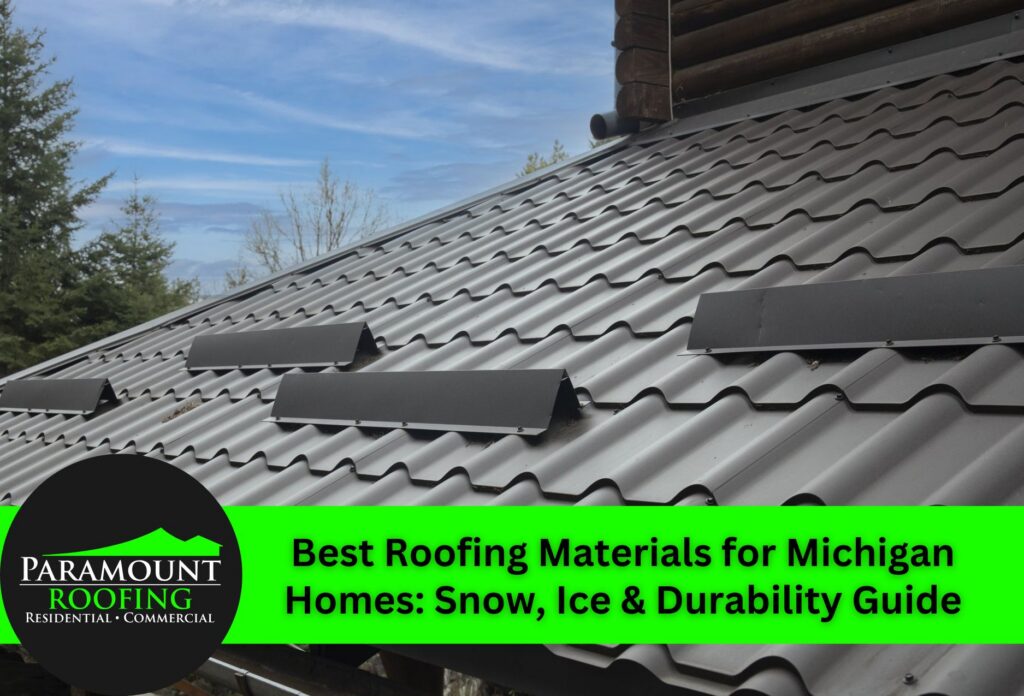
Metal roofing’s standing-seam profile actively sheds snow once accumulation exceeds 12 inches, which directly reduces ice dam formation, a major concern across Detroit winters. Asphalt shingles, by contrast, depend heavily on proper ventilation and ice-and-water shield underlayment to manage the same risk. Clay and concrete tiles weigh 8 to 12 lbs per square foot versus just 2 to 4 lbs for asphalt, making them impractical for mid-century Detroit homes without a professional engineering assessment first.
For most Detroit homeowners, architectural asphalt shingles offer the best balance of cost and cold-weather performance, while metal roofing is the strongest long-term investment for snow and temperature change resistance.
What Does A Roof Replacement Cost in Michigan, and Which Materials Offer the Best Value?
| Material | Average Cost for 2,000 sq ft of Roofing Materials | Estimated Lifespan | Approximate Cost per Year |
|---|---|---|---|
| Architectural Asphalt Shingles | $18,250 to $23,000 | 25 to 50 years | $550/year ($20,625 avg ÷ 37 years) |
| Metal (Standing Seam) | $12,500 to $40,000 | 40 to 70 years | $386/year ($21,250 avg ÷ 55 years) |
| Slate | $22,500 to $51,000 | 75 to 200 years | $267/year ($36,750 avg ÷ 137.5 years) |
| EPDM (flat/low-slope) | $6,000 to $20,000 | 20 to 30 years | $520/year ($13,000 avg ÷ 25 years) |
Keep in mind that Wayne County permit fees average $150 to $400, depending on the scale of the project.
Are Asphalt Shingles Still Worth It for Michigan Winters, or Does Metal Roofing Win?
Architectural asphalt shingles are installed on over 80% of Michigan homes because they balance upfront affordability with solid cold-weather performance, but metal roofing wins on longevity and snow shedding when budget allows. Neither material is the right answer for every Detroit home. The decision comes down to four factors: ice dam resistance, wind rating, algae resistance, and when the roof can be installed.
| Performance Factor | Architectural Asphalt (Class 4) | Standing Seam Metal |
|---|---|---|
| Ice Dam Resistance | Good requires an ice-and-water shield extending 24 inches past the interior wall line | Excellent sheds snow before ice dams can form |
| Wind Uplift Rating | Up to 130 mph with Class 4 impact-resistant shingles | 140+ mph with standing seam profile |
| Algae Resistance | Requires copper-infused granules for Michigan’s humid summers | Not susceptible to algae growth |
| Installation Seasonality | Cannot be installed below 40 degrees Fahrenheit without risk of cracking | No temperature restriction for installation |
For most Detroit homeowners, Class 4 impact-resistant architectural shingles with algae-resistant granules and proper ice-and-water shield underlayment deliver strong performance at a cost well under $12,000, making them the practical default for the majority of roofs. Homeowners planning to stay 30+ years with a budget of $15,000 or more should take a hard look at metal. Those with historic Detroit homes should evaluate slate alongside a structural assessment before committing to either option.
What Roofing Features Specifically Protect Against Freeze-Thaw Damage and Ice Dams in Detroit?
Five installation features work together to protect Detroit roofs from temperature change damage and ice dams, and skipping even one can shorten a 30-year shingle lifespan to just 18 to 22 years.
- Ice-and-water shield underlayment: Apply a minimum of 24 inches from the eave past the interior wall line. This self-sealing membrane is the first barrier against meltwater backing up under shingles during Detroit’s freeze-thaw swings.
- Attic ventilation at the IRC minimum ratio: The International Residential Code requires 1 square foot of ventilation for every 150 square feet of attic floor area. When attic temperatures exceed 32 degrees while outside temperatures stay below freezing, ice dams form, and a poorly ventilated attic can accelerate shingle deterioration by 30% to 40%.
- Synthetic underlayment rated to -40 degrees: Standard felt underlayment can crack in extreme cold. A synthetic product rated to -40 degrees stays flexible through Detroit’s harshest nights without splitting or losing adhesion.
- Drip edge metal: Required under Michigan’s adopted building code for proper water runoff. Drip edge directs meltwater away from the fascia board and prevents moisture from wicking back under shingles at the eave.
- Class 4 impact-resistant shingles (UL 2218 tested): Beyond hail protection, the reinforced construction handles repeated temperature changes better than standard shingles. Many Michigan homeowners’ insurance policies offer discounts of 15% to 30% for Class 4-rated roofs.
Ice dams are largely a ventilation problem, not just a shingle problem, so attic airflow and underlayment matter as much as the material on top. Roof installation in Detroit runs best from late April through October, when temperatures stay above 40 degrees and shingle adhesive seals correctly. Most manufacturer warranties require installation between 40 degrees and 85 degrees, so cold-weather installs risk voiding coverage before the first winter hits.
How Much Can Detroit Homeowners Save by Choosing the Right Roofing Material Upfront?
Upgrading from standard 3-tab asphalt shingles to architectural Class 4 impact-resistant shingles costs roughly $2,500 to $3,000 more upfront but avoids an entire re-roof cycle within 30 years, saving $6,000 to $8,000 in future replacement costs. Standard 3-tab shingles run $5,500 to $7,000 installed and carry a 20-year lifespan. Architectural Class 4 shingles cost $8,000 to $11,000 installed and last 27 to 30 years. That extra investment pays for itself without factoring in a single insurance discount.
Class 4 impact-rated shingles may reduce homeowners’ insurance premiums by 15% to 30% annually in Michigan. On a $1,500 per year policy, that equals $225 to $450 in annual savings. At that rate, the upgrade cost recovers itself within 6 to 12 years, and the shingles still have 15+ years of life remaining after the break-even point. Homeowners who plan to stay long-term should factor this discount into any material decision before signing a contract.
Metal roofing pushes the savings even further. Its reflective surface can reduce summer cooling costs by 10% to 25%, which matters during Detroit’s humid summers that regularly reach 90 degrees. Combined with a 40 to 70-year lifespan, most homeowners who choose metal never replace their roof again after installation. The higher upfront cost becomes less significant when spread across 5 or 6 decades of ownership. Homeowners interested in spreading out the cost of a new roof can explore roofing financing options to make the investment more manageable.
Ready to Replace Your Roof in Detroit? Here’s How to Get Started With the Right Material
Choosing the right roofing material now can save Detroit homeowners $6,000 to $8,000 in future replacement costs, but the window to schedule work runs from April through October, and contractor availability tightens fast as spring ramps up.
Paramount Roofing works with Detroit-area homeowners on material-specific estimates for projects ranging from $5,250 to $50,000+. Getting 2 to 3 quotes is standard practice, and Michigan requires state licensing for roofing projects above certain cost thresholds, so confirm your contractor is properly licensed before signing anything.
Not ready to schedule? Learn more about residential roof replacement options.