
 Free Estimate
 Request Service
 Locations
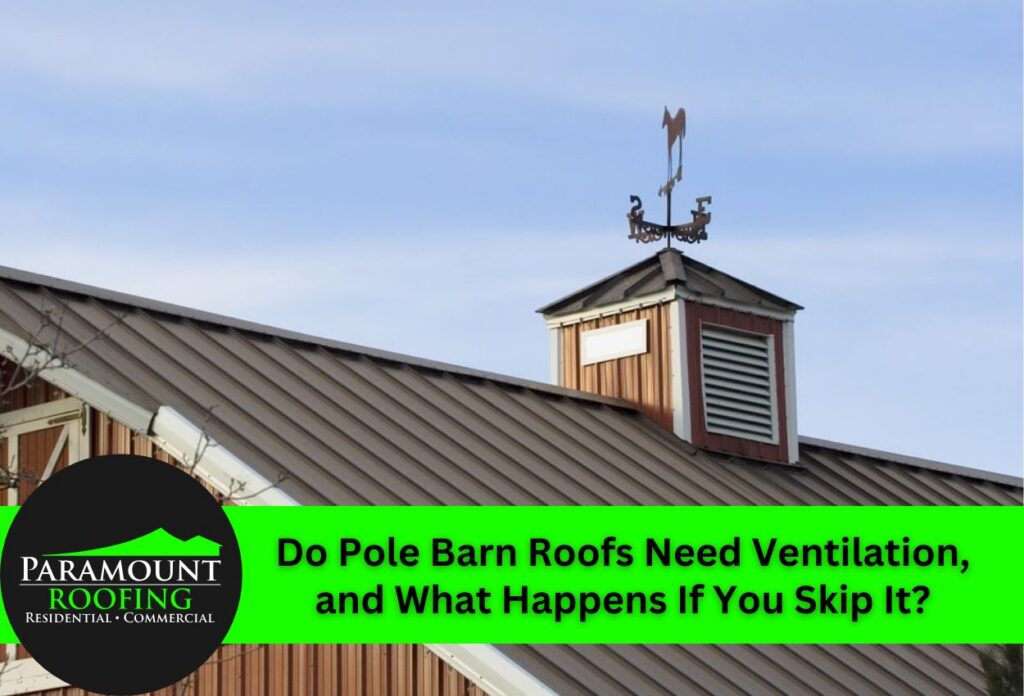

Yes, pole barn roofs absolutely need ventilation, especially in Detroit, where 40+ inches of annual snowfall and summer highs in the upper 80s create year-round moisture pressure from both directions. Winter cold drives condensation onto warm metal roof panels from the inside. Summer heat traps humidity with nowhere to escape. That back-and-forth cycle is hard on every material inside your barn.
Without proper airflow, interior humidity climbs above 50%, the point where mold growth, rust, and insulation breakdown all accelerate. The most common complaint from Detroit-area pole barn owners is “barn rain,” the dripping that happens when warm, moist interior air hits a cold metal roof and condenses into water droplets that fall onto equipment, vehicles, and stored goods below.
This article covers what happens when ventilation is skipped, how different ventilation options compare, how to estimate what your barn needs, warning signs to watch for, and what proper ventilation saves you in repair costs over time.
What Damage Does Poor Ventilation Cause in a Pole Barn Roof?
Poor ventilation causes five distinct failure modes in pole barn roofs, and in Detroit’s climate, all five can occur within a single winter season. Interior humidity above 50% is common in sealed pole barns during Michigan winters, and metal roofs drop below the dew point when outdoor temperatures fall below 20 degrees Fahrenheit, a condition Detroit sees on average 30 or more days per year.
- Condensation-driven rust on metal panels: When warm interior air repeatedly contacts cold metal, moisture collects on panel surfaces. This ongoing corrosion can cut a metal roof’s lifespan short by 10 to 15 years compared to a properly ventilated structure.
- Mold growth in insulation: Moisture absorbed into batt or blown insulation reduces its R-value by up to 40%, meaning a R30 roof assembly could perform closer to R18, well below Michigan’s recommended range for heated spaces.
- Wood purlin rot: Roof purlins sit directly under metal panels. Trapped moisture softens wood over time, weakening the structural framing that holds your roof together.
- Fastener and connector corrosion: Screws, brackets, and connectors corrode faster in high-humidity environments, loosening the connections that keep panels secured during Michigan’s heavy snow.
- Ice dam formation at eaves: Uneven roof temperatures from poor airflow cause snow to melt and refreeze at the eave line, forcing water under panels and into the structure below.
Heated pole barns used as garages or workshops carry the highest risk occupant activity, running machinery, and wide temperature differences between inside and outside, all of which push interior humidity higher than unheated storage buildings. Addressing ventilation before the first hard freeze gives Detroit barn owners the best chance of avoiding all five failure modes.
What Are the Best Pole Barn Roof Ventilation Options for Michigan Climates?
A paired ridge and soffit vent system delivers the most consistent passive airflow for Michigan pole barns, outperforming single-method approaches across cost, reliability, and cold-climate performance.
| Ventilation Method | Airflow Type | Net Free Area | Installed Cost Range | Best Use Case | Cold Climate Rating (1–5) |
|---|---|---|---|---|---|
| Continuous Ridge Vent | Passive | 18 sq in per linear foot | $500 – $1,200 | All pole barn types. Pairs with soffit vents | 5 |
| Soffit / Eave Vent | Passive | 9 to 18 sq in per linear foot | $300 – $900 | Intake paired with ridge vent exhaust | 4 |
| Gable Vent | Passive | 144 to 576 sq in per vent | $150 – $600 | Unheated storage barns with cross-ventilation | 3 |
| Powered Attic Fan | Active | 1,000 to 1,600 CFM per unit | $400 – $1,500 | Heated structures over 2,400 sq ft | 4 |
| Closed-Cell Spray Foam (Unvented Assembly) | Sealed | N/A no airflow required | $2,500 – $6,000+ | Fully heated, conditioned pole barns with R30 to R60 targets | 5 |
Ridge and soffit vents used together create the most reliable passive airflow because air enters low at the eaves and exits high at the ridge, a natural pressure difference that works even in still winter air. A 1:1 intake-to-exhaust ratio is the standard recommended by most ventilation codes, and matching the soffit net free area to the ridge net free area keeps that balance. Gable vents in Detroit-area barns should be positioned on the southwest-facing walls to align with the region’s prevailing wind direction, which improves cross-ventilation efficiency in unheated buildings.
Powered fans are most justified in heated barns over 2,400 sq ft, where passive systems alone may not move enough air during high-humidity winter conditions. For fully heated pole barns targeting R30 to R60 insulation values, closed-cell spray foam as a sealed assembly eliminates condensation risk by keeping the roof deck above the dew point.
How Do You Calculate the Right Amount of Ventilation for a Pole Barn Roof?
The standard formula is 1 sq ft of net free area (NFA) per 150 sq ft of floor space or 1 sq ft per 300 sq ft if a vapor barrier is installed. For a 40×60 ft pole barn (2,400 sq ft), that means 16 sq ft of NFA at the 1:150 ratio, or 8 sq ft at the 1:300 ratio. Two numbers determine which formula applies: total floor square footage and whether the space is heated.
In Michigan’s climate zone, heated pole barns used as garages or workshops require insulation in the R-30 to R-60 range. That level of insulation changes how moisture moves through the building, which affects whether a vapor barrier is realistic and which ratio to apply. Heated, uninsulated barns should always use the 1:150 ratio, the more demanding standard, because without a proper vapor barrier, moisture has no managed exit point.
| Pole Barn Size | Floor Area | Min. NFA at 1:150 | Min. NFA at 1:300 |
|---|---|---|---|
| 30×40 ft | 1,200 sq ft | 8 sq ft | 4 sq ft |
| 40×60 ft | 2,400 sq ft | 16 sq ft | 8 sq ft |
| 60×80 ft | 4,800 sq ft | 32 sq ft | 16 sq ft |
Split NFA evenly between intake (soffit) and exhaust (ridge) vents to maintain balanced airflow. If your barn doesn’t meet the minimum for its size, adding a continuous ridge vent is usually the fastest fix.
What Are the Signs of Poor Ventilation in a Pole Barn You Shouldn’t Ignore?
If 3 or more of the following signs are present, your pole barn needs ventilation remediation before the next Detroit winter season, and a full self-evaluation takes under 15 minutes.
- Water dripping from roof panels on cold mornings: This is “barn rain” condensation forming when warm interior air contacts cold metal. Even occasional dripping means the humidity inside the barn is already above a safe threshold.
- Rust streaks on interior metal surfaces: Rust appearing within 2 to 3 years of construction signals chronic moisture exposure, not just bad weather. New metal should not rust that fast.
- Black or green staining on wood framing: Mold and mildew on purlins or wall framing confirm that surface moisture has been present long enough for biological growth to take hold.
- Damp or compacted insulation: Insulation that feels wet or matted has already lost R-value. If heating costs have climbed 15% to 25% with no other explanation, degraded insulation is a likely cause.
- Frost on interior roof surfaces in January or February: Frost buildup inside the barn means interior humidity is freezing directly onto cold panels, a sign that warm, moist air has nowhere to escape.
- Condensation on windows or walls lasting more than 2 hours after a temperature change: Surface moisture that lingers that long points to trapped humidity that ventilation would otherwise clear out.
Do not put off acting on these signs. Most metal roofing panel warranties require adequate ventilation as a stated condition, typically within the first 5 to 10 year coverage window, and unaddressed ventilation problems can void that protection entirely. If the checklist flags 3 or more items, contact a reputable roofing contractor to assess your current setup. Before temperatures drop, a residential roof inspection can identify ventilation gaps before they become expensive repairs.
How Much Does Pole Barn Roof Ventilation Cost, and What Do You Save Long-Term?
A passive ridge and soffit vent system for a 40×60 pole barn averages $800 to $2,500 installed, a fraction of the $4,000 to $19,000+ in repairs that poor ventilation can trigger over time.
| Ventilation Solution | Installed Cost Range | Estimated Lifespan | Est. Annual Energy or Maintenance Savings | Payback Period |
|---|---|---|---|---|
| Continuous Ridge Vent | $500 – $1,200 | 20 to 30 years | $150 – $300 in reduced maintenance costs | 4 to 6 years |
| Soffit Vent Installation | $300 – $900 | 20 to 30 years | $100 – $200 in reduced maintenance costs | 3 to 5 years |
| Powered Attic Ventilator | $400 – $1,500 | 10 to 15 years | $200 – $400 in energy and moisture damage savings | 4 to 7 years |
| Spray Foam Unvented Assembly | $2,500 – $6,000+ | 30 to 40 years | $400 – $800 in energy savings | 6 to 10 years |
Reactive repair costs tell the real story. Metal panel replacement runs $4 to $9 per sq ft. Purlin replacement costs $1,500 to $4,000 per repair zone. Mold remediation adds another $2,000 to $6,000. A single round of all three repairs can easily exceed $10,000 on a ventilation problem that a $1,200 ridge and soffit system could have prevented, and when damage is severe enough, a full residential roof replacement may be the only option.
Michigan property owners also benefit from a longer roof life: properly ventilated and insulated metal roofs last 35 to 40 years versus 20 to 25 years on unventilated structures. That 15-year lifespan extension alone can delay a full roof replacement by a decade or more, making early ventilation investment one of the highest-return decisions a pole barn owner can make.
Ready to Fix Your Pole Barn Roof Ventilation in Detroit?
Avoiding $10,000+ in rust, mold, and panel replacement starts with one conversation, and late summer or early fall is the best time to act before Michigan winters arrive. Paramount Roofing works with Detroit-area pole barn owners to assess ventilation gaps and recommend the right system for each structure’s size and use.
Before calling, run the NFA calculation from earlier in this article. Knowing your floor square footage and whether your barn is heated helps you walk into that conversation already understanding your minimum ventilation target.
Get your free estimate.
Not ready to schedule? Learn more about metal roof ventilation solutions.